The telecom industry is entering a new era driven by 5G, cloud computing, Internet of Things (IoT), edge computing, and rapidly changing customer expectations. As networks become more complex, telecom providers need smarter ways to manage infrastructure, services, customers, and revenue. This is where OSS BSS systems play an increasingly important role.
Unlike traditional telecom platforms designed around older network architectures, modern OSS and BSS solutions help operators coordinate network operations with business processes. When integrated with 5G infrastructure, they can support faster service activation, real-time monitoring, automated billing, improved customer experiences, and more efficient resource management.
What Are OSS BSS Systems?
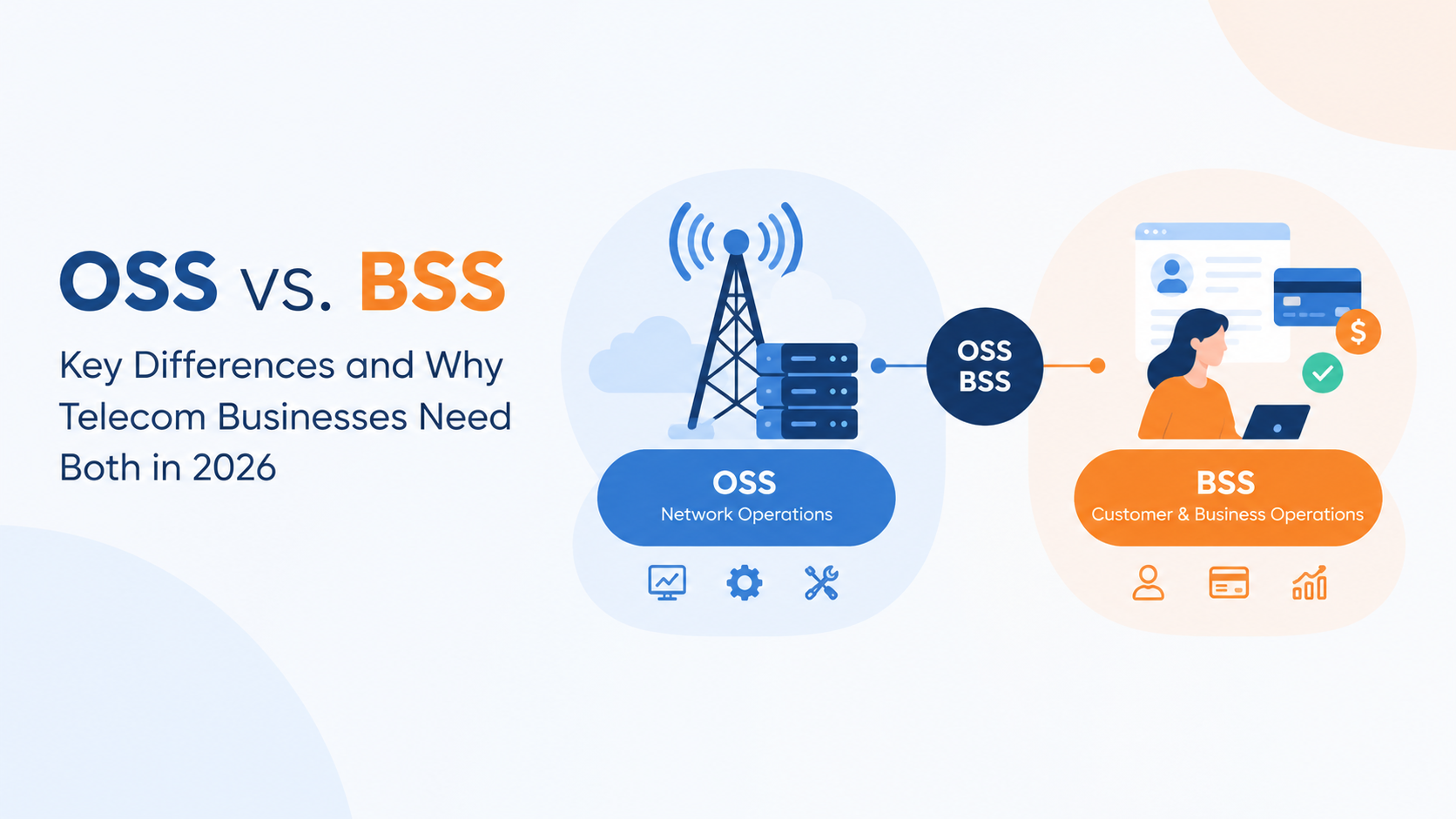
OSS stands for Operations Support Systems, while BSS means Business Support Systems. Together, OSS BSS systems connect the technical and commercial sides of a telecommunications business.
OSS generally handles network-focused activities such as:
- Network monitoring and management
- Service provisioning
- Fault detection and resolution
- Resource management
- Network inventory
- Performance monitoring
BSS focuses more on customer and business operations, including:
- Customer management
- Product and service management
- Billing and charging
- Payments
- Order management
- Revenue management
When these systems work together, telecom providers can manage services from network deployment through customer billing and support.
Why 5G Requires Modern OSS BSS Systems
5G networks are significantly more dynamic than previous generations of mobile infrastructure. They support massive device connectivity, higher speeds, lower latency, network slicing, edge computing, and a wider range of enterprise services.
This creates operational challenges for telecom providers.
For example, a business customer may require a customized 5G service with specific performance, security, and bandwidth requirements. Managing such a service manually across multiple systems can create delays and operational errors.
Modern OSS BSS systems can help automate these processes by connecting customer orders with service provisioning and network resources. This allows providers to respond faster while reducing repetitive manual work.
Key Benefits of OSS BSS Systems for 5G
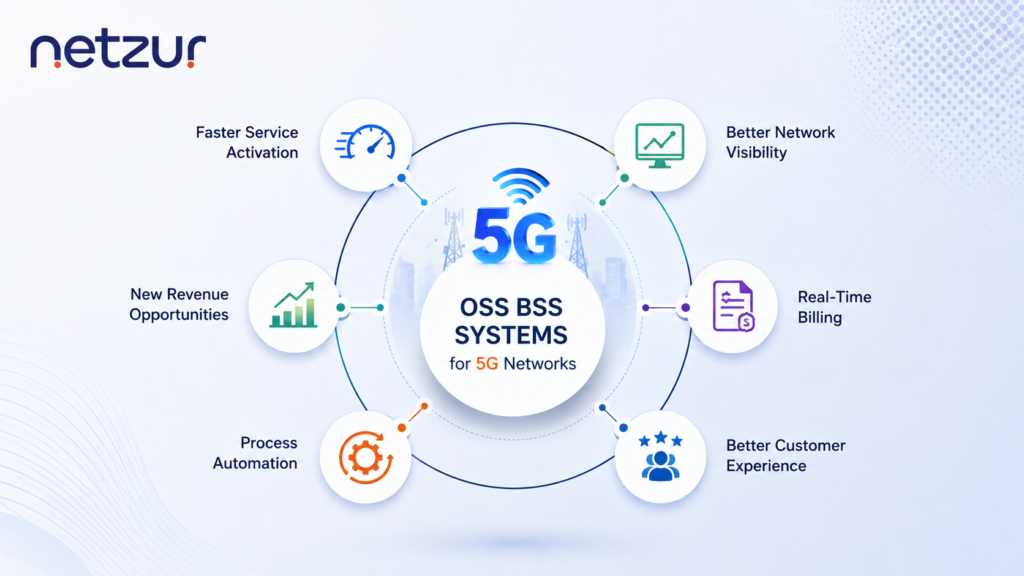
1. Faster Service Activation
5G customers increasingly expect services to become available quickly. Automated provisioning can connect BSS order processes with OSS network functions, helping providers activate services more efficiently.
This is especially useful for enterprise customers that require customized connectivity, private 5G networks, or managed communication services.
2. Better Network Visibility
5G environments can involve numerous network elements, cloud platforms, edge locations, and connected devices. OSS capabilities provide greater visibility into network performance and infrastructure.
Operators can monitor resources, identify potential issues, and respond to service disruptions more effectively.
3. Real-Time Billing and Charging
5G introduces new monetization opportunities. Telecom companies can offer services based on usage, bandwidth, quality of service, application requirements, or customized enterprise packages.
BSS platforms can support flexible charging and billing models, allowing providers to move beyond traditional fixed subscription structures.
4. Improved Customer Experience
Customers expect digital-first experiences, including quick ordering, accurate invoices, real-time service information, and responsive support.
Integrated OSS BSS systems help connect customer-facing processes with backend operations. This can reduce delays between purchasing a service and receiving it while also improving the accuracy of customer information and billing.
5. Support for Network Slicing
One of the important capabilities associated with 5G is network slicing. It allows network resources to be logically separated to support different requirements.
For example, an industrial application may need reliable low-latency connectivity, while another service may prioritize high bandwidth.
Managing these differentiated services requires coordination between business requirements and network resources. Integrated OSS and BSS platforms can help translate commercial service requirements into operational processes.
OSS BSS Systems and 5G Monetization
5G is not simply about faster mobile internet. It creates opportunities for telecom providers to develop new revenue streams across industries such as healthcare, manufacturing, logistics, retail, automotive, and smart cities.
To monetize these opportunities, operators need flexible product catalogs, dynamic charging, automated ordering, and efficient service provisioning.
BSS capabilities can help providers create and manage new service packages, while OSS capabilities can support the underlying network resources. This combination creates a foundation for delivering more customized 5G services.
According to the GSMA, 5G continues to expand across consumer and enterprise applications, making scalable digital infrastructure increasingly important for operators.
The Role of Automation and AI
Automation is becoming a major trend in telecom operations. Modern platforms can automate provisioning, monitoring, billing workflows, and service management.
AI can further enhance these capabilities by helping identify unusual network behavior, predict potential failures, analyze customer patterns, and support intelligent decision-making.
For example, predictive analytics can help operators identify network issues before they significantly affect customers. On the business side, analytics can help identify usage patterns and opportunities for new services.
The International Telecommunication Union (ITU) also highlights the growing importance of emerging technologies and intelligent network capabilities in the evolution of telecommunications.
Challenges When Implementing OSS BSS Systems
Despite their benefits, implementing modern OSS BSS systems can be challenging. Telecom providers may need to integrate new platforms with legacy infrastructure, multiple network technologies, databases, and third-party applications.
Data migration, system interoperability, cybersecurity, scalability, and employee training are also important considerations.
A phased modernization strategy can help organizations reduce disruption. Instead of replacing every legacy component at once, providers can prioritize critical processes and gradually introduce automation and cloud-based capabilities.
Future of OSS BSS Systems in 5G
The future of telecom management will increasingly depend on automation, cloud-native architecture, real-time analytics, AI, and API-based integration.
As 5G expands into enterprise applications and connected ecosystems, OSS BSS systems will need to become more flexible and intelligent. Providers will increasingly require platforms capable of managing complex services while delivering faster customer experiences.
The combination of 5G, edge computing, IoT, AI, and cloud technologies is likely to create even more demand for integrated operational and business systems.
Conclusion
5G is transforming telecommunications from traditional connectivity into a broader digital services ecosystem. OSS BSS systems provide the operational and business foundation needed to manage this transformation, from network resources and service provisioning to billing and customer management.
For telecom providers looking to modernize their infrastructure, solutions from Netzur can support smarter telecom operations and management while helping businesses adapt to the evolving demands of next-generation networks.
FAQ
1. What are OSS BSS systems in telecom?
OSS BSS systems combine Operations Support Systems and Business Support Systems. OSS manages network and service operations, while BSS manages customer, billing, ordering, and revenue-related processes.
2. Why are OSS BSS systems important for 5G?
OSS BSS systems help telecom providers manage the greater complexity of 5G networks. They support automation, service provisioning, network management, flexible billing, customer management, and new 5G monetization models.