
The telecom industry is entering a new era where connectivity is no longer the only measure of success. With 5G, fiber, IoT, cloud services, edge computing, and AI-powered applications rapidly expanding, telecom operators are managing increasingly complex networks and diverse service portfolios. At the same time, customers expect instant activation, accurate billing, personalized offers, and seamless digital experiences.
This transformation is driving growing demand for telecom billing and OSS solutions that can combine automation, real-time data, intelligent decision-making, and flexible service management. Traditional systems built around rigid processes and disconnected platforms are finding it difficult to keep pace with modern telecom requirements.
In 2026, the focus is shifting toward intelligent, cloud-native, and AI-enabled operations that can help telecom providers move from reactive management to proactive and increasingly autonomous operations.
Why Telecom Billing and OSS Solutions Are Becoming More Intelligent
Telecom billing and operations support have traditionally relied on separate systems for customer management, charging, billing, network monitoring, provisioning, and service assurance. As telecom networks have evolved, these systems have become more interconnected – but legacy architectures can still create data silos and operational complexity.
Modern telecom billing and OSS solutions are designed to bring greater intelligence into these processes. They can connect operational data with billing and customer information, enabling providers to make faster decisions and respond more effectively to changing network conditions and customer demands.
The rise of AI is accelerating this shift. According to TM Forum, the telecom industry is moving toward AI-native operations, with a growing focus on autonomous workflows, intelligent orchestration, and AI working alongside existing OSS and BSS environments.
This means the future of telecom operations is not simply about replacing legacy systems. It is about creating intelligent ecosystems where automation, analytics, and human oversight work together.
5 Trends Shaping Intelligent Telecom Billing and OSS
1. AI-Powered Automation
Artificial intelligence is becoming one of the biggest drivers of telecom transformation. Instead of relying entirely on manual monitoring and intervention, operators can use AI to identify patterns, detect anomalies, predict potential issues, and recommend actions.
For billing, AI can help identify unusual usage patterns, detect potential revenue leakage, and support more personalized customer offers. On the operational side, intelligent systems can assist with fault detection, root-cause analysis, and service assurance.
The next step is agentic AI, where AI-powered agents can coordinate actions across different systems. Industry initiatives are increasingly exploring how AI agents can work with OSS and BSS platforms while maintaining governance, security, and accountability.
2. Real-Time Charging and Flexible Monetization
The telecom business model is moving beyond traditional monthly subscriptions. Operators are exploring usage-based services, enterprise connectivity, IoT, network APIs, network slicing, cloud connectivity, and partner-based offerings.
This creates a need for billing platforms capable of supporting flexible charging models and real-time monetization.
Modern telecom billing and OSS solutions can help operators manage prepaid, postpaid, hybrid, event-based, and usage-based charging requirements. Real-time charging also enables providers to respond quickly to customer usage and service changes.
As programmable networks and APIs create new monetization opportunities, flexible charging infrastructure will become increasingly important for turning technical capabilities into sustainable revenue streams.
3. Cloud-Native OSS and BSS Architecture
Cloud-native technology is becoming a foundation for telecom modernization. Microservices, APIs, containerized applications, and modular architectures allow operators to scale systems more efficiently and introduce new capabilities without completely rebuilding their technology stack.
For telecom providers, cloud-native telecom billing and OSS solutions can offer greater flexibility when launching new services or integrating third-party platforms.
Cloud-native architecture also creates a stronger foundation for AI adoption. Modern infrastructure can help telecom providers process large volumes of data and integrate intelligent technologies into existing operational environments.
4. Intent-Based and Autonomous Operations
One of the most exciting developments in telecom is the move toward intent-based operations. Instead of manually defining every technical action, an operator can specify the desired business or service outcome, while intelligent systems determine how to achieve it.
For example, if an enterprise requires improved connectivity for a critical application, an intelligent operational environment could assess network conditions, allocate resources, monitor performance, and make adjustments automatically.
This approach is closely connected to the industry’s movement toward autonomous networks. AI-native architectures are increasingly being designed to connect intent, orchestration, assurance, and action across IT and network environments.
5. Data-Driven Customer Experience
Billing is no longer just a financial process. It is an important part of the overall customer experience.
Unexpected charges, unclear invoices, delayed updates, and billing errors can quickly damage customer trust. Intelligent billing platforms can use real-time data and analytics to provide greater transparency and help identify potential issues before they become customer complaints.
By connecting billing information with customer behavior and service data, telecom providers can also create more personalized plans, usage alerts, and recommendations.
The result is a more proactive customer journey where operators can respond to customer needs rather than simply reacting to support requests.
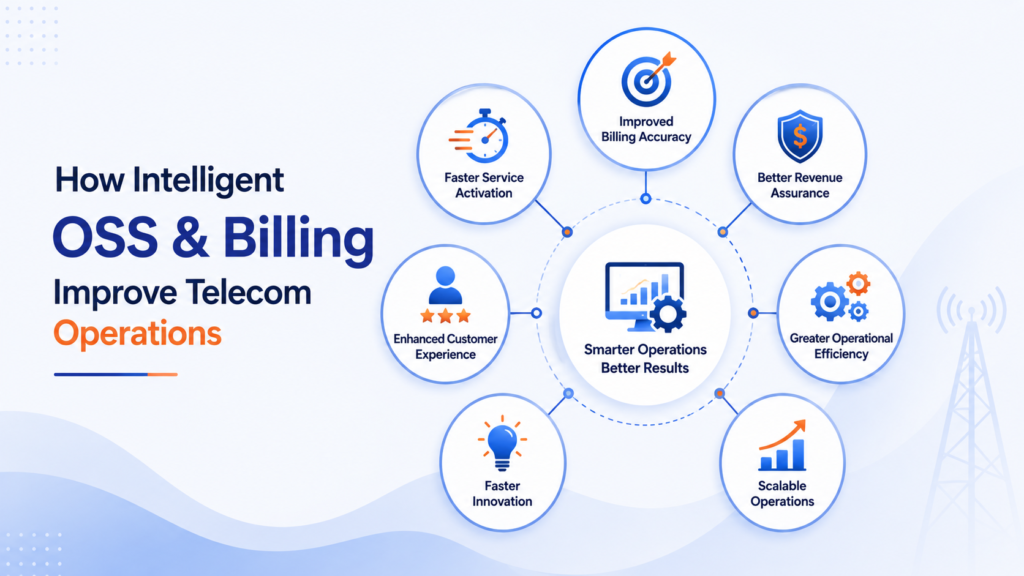
How Intelligent OSS and Billing Can Improve Telecom Operations
The benefits of intelligent telecom billing and OSS solutions extend across both business and network operations. Key advantages include:
- Improved billing accuracy: Automated data collection and processing can reduce manual errors.
- Faster service activation: Automated workflows can accelerate provisioning and service delivery.
- Better revenue assurance: Intelligent analytics can help identify billing inconsistencies and potential revenue leakage.
- Greater operational efficiency: Automation reduces repetitive manual tasks and improves resource utilization.
- Enhanced customer experience: Real-time information supports faster responses and more transparent billing.
- Faster innovation: Flexible architectures make it easier to launch new products and services.
- Scalable operations: Cloud-native platforms can support growing subscriber bases and increasingly complex services.
These benefits become especially important as telecom providers expand into enterprise connectivity, IoT, digital services, and API-driven business models.
What Should Telecom Providers Look for in Modern Solutions?
When evaluating telecom billing and OSS solutions, operators should consider more than basic billing and network management features. Modern platforms should support open APIs, cloud-native deployment, real-time data processing, automation, scalable architecture, and integration with existing systems.
AI readiness should also be an important consideration. As intelligent automation becomes more widespread, platforms need to provide reliable access to high-quality data while maintaining appropriate security, governance, and human oversight.
Interoperability is equally critical. Telecom environments often include equipment and software from multiple vendors, making standardized interfaces and modular architecture essential for long-term flexibility.
The Future of Telecom Billing and OSS Solutions
The telecom industry is moving toward a future where billing, service management, network operations, and customer experience are increasingly connected. AI, cloud-native architecture, real-time monetization, and autonomous operations are changing how providers manage both their networks and their businesses.
The future will not be defined by AI replacing every existing system. Instead, successful telecom operators will increasingly combine intelligent technologies with trusted systems, standardized APIs, strong governance, and human expertise.
As telecom services become more dynamic, telecom billing and OSS solutions will play an increasingly important role in connecting network capabilities with commercial outcomes. Providers that modernize their operational and billing infrastructure today will be better positioned to adapt to emerging technologies and new revenue opportunities.
Conclusion
The rise of intelligent telecom billing and OSS solutions is reshaping how telecom providers manage networks, deliver services, and create new revenue opportunities. With AI-powered automation, real-time charging, cloud-native infrastructure, intent-based operations, and data-driven customer experiences becoming increasingly important, modern telecom providers need systems that can adapt to a rapidly changing digital landscape.
As networks become more complex and customer expectations continue to rise, investing in flexible and intelligent OSS and billing infrastructure can help providers improve efficiency, strengthen revenue management, accelerate service delivery, and build better customer experiences. The future of telecom will depend on the ability to connect network intelligence with business operations – and the right technology foundation will be essential to achieving that goal.
For telecom and connectivity providers looking to simplify operations, automate billing, and build scalable network management capabilities, Netzur offers solutions designed to support the evolving demands of modern telecom businesses.
FAQ
1. What are telecom billing and OSS solutions?
Telecom billing and OSS solutions are software platforms that help communication service providers manage billing, charging, service provisioning, network operations, monitoring, and service assurance. Modern solutions increasingly integrate automation, analytics, APIs, and AI capabilities to improve operational efficiency and customer experience.
2. Why are AI-powered telecom billing and OSS solutions important?
AI-powered solutions can help telecom providers automate repetitive processes, identify anomalies, analyze large volumes of operational data, improve billing accuracy, and support proactive network management. As telecom networks become more complex, AI can help operators move toward faster, more intelligent, and increasingly autonomous operations.
