
The global rollout of 5G is transforming the telecommunications industry, enabling faster connectivity, lower latency, and support for emerging technologies such as IoT, smart cities, autonomous vehicles, and industrial automation. However, managing a 5G network is significantly more complex than previous generations of wireless technology. Telecom operators must handle massive amounts of data, dynamic network resources, and diverse service requirements.
This is where OSS BSS software plays a crucial role. Modern OSS and BSS platforms provide the operational and business intelligence needed to manage 5G networks efficiently, ensuring seamless service delivery, improved customer experiences, and optimized network performance.
Understanding OSS and BSS in Telecom
Before exploring their role in 5G, it is important to understand the two core components.
Operations Support Systems (OSS)
OSS focuses on network-related operations, including:
- Network monitoring
- Service provisioning
- Fault management
- Performance management
- Resource inventory
These capabilities help operators maintain network reliability and service quality.
Business Support Systems (BSS)
BSS handles customer-facing and business processes such as:
- Billing and charging
- Customer relationship management (CRM)
- Order management
- Revenue assurance
- Product and service management
Together, OSS and BSS create a unified framework that bridges network operations with business objectives.
Why 5G Requires Advanced OSS BSS Software
Unlike traditional networks, 5G introduces a highly flexible and software-driven architecture. Operators must manage multiple services simultaneously while maintaining performance standards.
Some of the key challenges include:
- Massive device connectivity
- Network slicing management
- Ultra-low latency requirements
- Dynamic resource allocation
- Complex service orchestration
- Real-time billing requirements
Traditional systems often struggle to meet these demands. Modern OSS BSS telecom platforms provide the automation and intelligence needed to manage these complexities effectively.
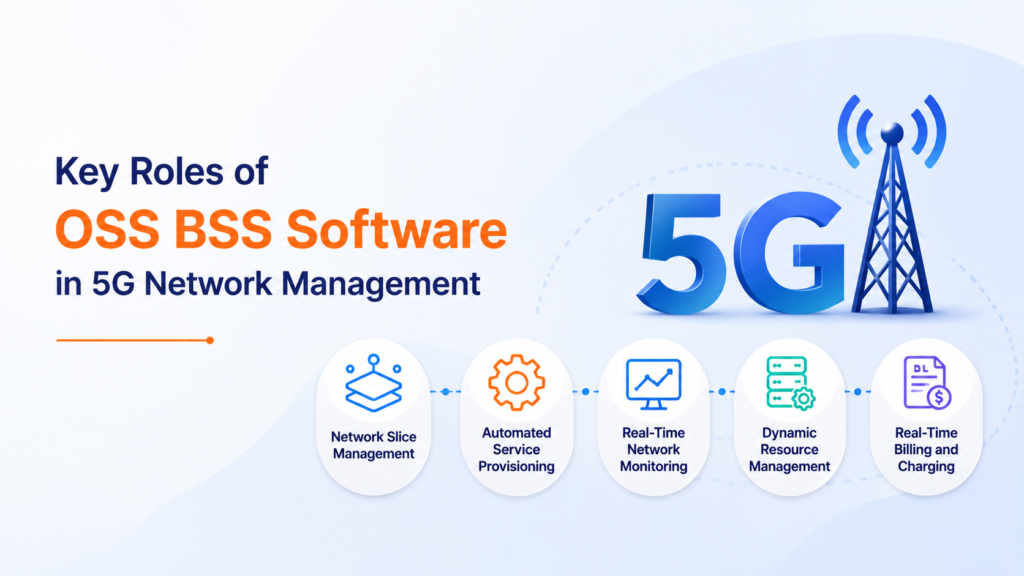
Key Roles of OSS BSS Software in 5G Network Management
1. Network Slice Management
One of the most revolutionary features of 5G is network slicing. This allows operators to create multiple virtual networks on a single physical infrastructure.
For example:
- A healthcare provider may require ultra-reliable low-latency communication.
- A streaming service may need high-bandwidth connectivity.
- An IoT deployment may prioritize device density.
OSS systems help create, monitor, and optimize these network slices, while BSS platforms ensure accurate billing and service management for each slice.
2. Automated Service Provisioning
5G services need to be activated quickly and efficiently. Manual provisioning can lead to delays and operational inefficiencies.
Modern OSS platforms automate:
- Service activation
- Configuration management
- Resource allocation
- Network deployment workflows
This automation accelerates service delivery and reduces operational costs.
3. Real-Time Network Monitoring
5G networks generate enormous volumes of operational data.
Advanced OSS solutions provide:
- Real-time network visibility
- Performance analytics
- Fault detection
- Predictive maintenance
By identifying potential issues before they affect customers, operators can improve network reliability and reduce downtime.
4. Dynamic Resource Management
Network demand fluctuates constantly throughout the day.
OSS BSS software helps operators:
- Monitor traffic patterns
- Allocate resources dynamically
- Optimize bandwidth utilization
- Improve overall network efficiency
This ensures consistent service quality even during peak usage periods.
5. Real-Time Billing and Charging
5G introduces new business models that require flexible charging mechanisms.
Examples include:
- Usage-based pricing
- Network slice billing
- IoT connectivity subscriptions
- Enterprise service packages
Modern BSS platforms support real-time billing and charging, allowing operators to monetize new 5G services effectively.
The Impact of AI on OSS BSS Telecom Platforms
Artificial Intelligence is becoming an essential component of modern OSS BSS software.
AI-powered capabilities include:
Predictive Maintenance
Machine learning algorithms analyze network data to predict equipment failures before they occur.
Intelligent Automation
Routine operational tasks can be automated, reducing manual workloads and improving efficiency.
Customer Experience Optimization
AI helps identify customer behavior patterns, enabling personalized service offerings and proactive support.
Revenue Optimization
Advanced analytics provide insights that help operators maximize profitability while maintaining competitive pricing.
Cloud-Native OSS and BSS for 5G
Many telecom providers are moving away from legacy systems and adopting cloud-native architectures.
Benefits include:
- Improved scalability
- Faster deployment cycles
- Greater flexibility
- Reduced infrastructure costs
- Enhanced disaster recovery capabilities
Cloud-native OSS BSS solutions are particularly valuable for managing rapidly growing 5G ecosystems.
Many telecom providers are moving away from legacy systems and adopting cloud-native architectures. According to TM Forum, cloud-native OSS and BSS platforms enable telecom operators to improve scalability, accelerate service deployment, and support the growing demands of 5G networks.
Benefits of OSS BSS Software in 5G Environments
Faster Service Launches
Automation enables telecom operators to introduce new services quickly.
Improved Network Performance
Continuous monitoring and optimization ensure reliable connectivity.
Enhanced Customer Satisfaction
Personalized experiences and proactive issue resolution improve customer retention.
Increased Operational Efficiency
Automation reduces manual processes and operational expenses.
Better Revenue Management
Flexible charging models help operators monetize emerging 5G services effectively.
Future Trends in OSS BSS and 5G
As 5G adoption accelerates, OSS and BSS platforms will continue evolving.
Key trends include:
- Autonomous network operations
- AI-driven service orchestration
- Open API integration
- Edge computing support
- Zero-touch network management
- Advanced analytics and predictive intelligence
These innovations will help telecom operators manage increasingly complex network environments while delivering exceptional customer experiences.
As 5G adoption accelerates, telecom operators are investing heavily in automation, AI, and advanced analytics. Recent insights from GSMA Intelligence highlight how 5G services are driving new revenue opportunities and transforming network management strategies worldwide.
Conclusion
The success of 5G depends not only on advanced network infrastructure but also on intelligent operational and business management systems. Modern OSS BSS software provides the automation, visibility, and flexibility required to manage complex 5G environments efficiently. From network slicing and real-time monitoring to billing and customer management, OSS and BSS platforms play a central role in enabling the next generation of telecom services. Companies seeking scalable OSS BSS telecom solutions can explore innovative platforms from Netzur Technologies to support their 5G transformation journey.
FAQs
1. What is the role of OSS BSS software in 5G networks?
OSS BSS software helps telecom operators manage network operations, automate service provisioning, monitor performance, handle billing, and support network slicing in 5G environments.
2. Why is real-time billing important in 5G?
5G enables new business models such as network slicing and IoT services. Real-time billing allows operators to charge accurately based on usage, services, and customer requirements.
