Internet Service Providers (ISPs) are facing increasing pressure to expand their subscriber base, manage multiple resellers, and deliver reliable connectivity while maintaining profitability. As wireless internet businesses grow, manual billing, payment tracking, and reseller commission calculations can become difficult to manage. These challenges make automation an important part of modern ISP operations.
A wireless reseller billing platform helps ISPs simplify billing, manage reseller networks, monitor subscriber accounts, and streamline revenue collection through a centralized system. In 2026, combining cloud-based management, automated workflows, and real-time reporting can help internet providers scale their businesses more efficiently.
Why Wireless ISPs Need Smarter Reseller Management
Wireless internet providers often work with multiple resellers who serve customers across different locations. Each reseller may manage different subscriber volumes, pricing plans, payment cycles, and service requirements.
Managing these activities through spreadsheets or disconnected systems increases the risk of billing errors, delayed payments, and inconsistent reporting. As the business expands, these issues can consume valuable time and affect customer satisfaction.
A centralized billing solution gives ISPs better visibility into reseller activities, subscriber accounts, and financial performance. Instead of relying on repetitive manual tasks, teams can use structured workflows to manage operations and focus on business development.
5 Ways a Wireless Reseller Billing Platform Helps ISPs Scale Faster
1. Automates Billing and Payment Collection
Manual billing becomes increasingly difficult when an ISP serves thousands of subscribers through multiple resellers. Automated billing helps generate invoices according to predefined plans, billing cycles, and account configurations.
The platform can also support payment reminders, overdue account tracking, and service suspension or reactivation workflows, depending on the system’s capabilities.
By reducing repetitive administrative work, ISPs can process recurring payments more consistently and give their finance teams more time to focus on revenue management.
2. Simplifies Multi-Level Reseller Management
Expanding an ISP business often means onboarding new resellers, distributors, or franchise partners. Without a centralized system, managing their accounts and subscriber portfolios can become complicated.
A wireless reseller billing platform can organize reseller accounts, assign suitable packages, track customer connections, and monitor performance from one interface. Depending on the platform, hierarchical access controls can also help resellers manage their permitted activities independently.
This structure makes it easier to expand into new markets without increasing administrative complexity at the same rate.
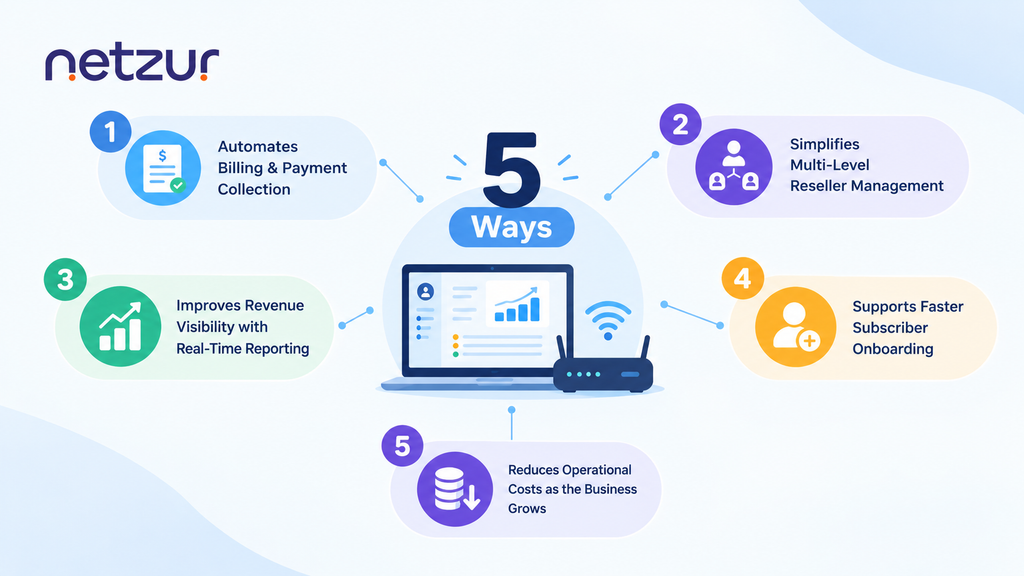
3. Improves Revenue Visibility with Real-Time Reporting
Business growth requires accurate information about revenue, subscriber activity, outstanding payments, and reseller performance. Delayed reports can make it difficult to identify problems before they affect profitability.
Centralized reporting helps ISP teams monitor important business indicators, compare reseller performance, and identify payment collection trends. Financial and operational dashboards can also highlight inactive accounts, overdue invoices, and changes in subscriber growth.
With better visibility, decision-makers can use actual business data to improve pricing strategies, allocate resources, and plan expansion.
4. Supports Faster Subscriber Onboarding
A growing wireless ISP needs an efficient process for adding subscribers, activating services, assigning packages, and managing account details. Disconnected systems can create unnecessary delays and increase the likelihood of incorrect configurations.
Integrated subscriber management and billing workflows help teams coordinate account creation, package assignment, payment status, and service activation. Where supported, network integrations can further reduce manual intervention in provisioning and account management.
A smoother onboarding experience helps ISPs serve new customers more efficiently while maintaining consistent operational processes.
5. Reduces Operational Costs as the Business Grows
Hiring additional staff to handle every new subscriber or reseller is not always a sustainable growth strategy. Automation allows existing teams to manage more routine work without increasing manual effort proportionally.
By consolidating billing, subscriber management, reseller operations, and reporting, ISPs can reduce duplicated data entry and simplify daily workflows.
The result is a more scalable operating model that allows teams to direct their time toward customer support, network reliability, and new business opportunities.
Emerging ISP Trends to Watch in 2026
Several technology trends are influencing how wireless internet businesses operate.
- Cloud-based operations: Centralized access helps authorized teams manage billing and reseller activities across multiple locations.
- AI-assisted analytics: AI tools can help summarize operational data, identify unusual patterns, and support faster business decisions when connected to reliable data sources.
- Integrated network management: Connecting billing with subscriber authentication and network systems can help coordinate service activation and account status.
- Self-service experiences: Subscriber and reseller portals can reduce support requests by making account information, invoices, and payment details easier to access.
- Data-driven expansion: Reporting tools help providers identify growth opportunities and understand which reseller channels perform best.
Choosing solutions that support relevant integrations and secure access controls can help ISPs prepare for future growth without unnecessarily complicating their operations.
According to Deloitte’s 2026 Telecom Industry Predictions, telecom providers are increasingly exploring cloud modernization, automation, and AI-enabled operational systems to improve efficiency and support new services.
How to Choose the Right Billing Platform
Before selecting a solution, ISPs should evaluate their current business requirements and long-term expansion plans. Important considerations include automated recurring billing, flexible pricing plans, reseller hierarchy management, payment integrations, subscriber authentication, reporting, and customer support workflows.
Security is equally important. Look for role-based permissions, appropriate data protection measures, audit trails, and reliable backup procedures. Providers should also assess integration options, implementation requirements, scalability, and the quality of technical support.
The best platform is not necessarily the one with the most features. It is the one that fits the ISP’s operating model, reduces avoidable manual work, and supports future business requirements.
Insights from IDC’s Wholesale Telecommunications Insights highlight the growing importance of automation, APIs, and flexible service models in wholesale telecommunications.
Conclusion
Scaling a wireless ISP in 2026 requires more than acquiring subscribers. Providers also need efficient billing, organized reseller management, reliable reporting, and streamlined operational workflows. A wireless reseller billing platform can bring these functions together, helping businesses manage growth while improving visibility and reducing administrative overhead.
For ISPs looking to modernize their operations, Netzur offers a platform designed to support ISP billing, subscriber management, reseller operations, and network-related workflows. Evaluating the right combination of automation and integrations can help providers build a more scalable foundation for long-term growth.
FAQ
1. What is a wireless reseller billing platform?
A wireless reseller billing platform is software that helps internet providers manage subscriber billing, reseller accounts, payment tracking, pricing plans, and related operational activities through a centralized system.
2. How does reseller billing software help ISPs grow?
It reduces manual billing work, organizes reseller networks, improves financial reporting, and helps teams manage more subscribers without proportionally increasing administrative effort.
3. Can a billing platform manage multiple resellers?
Yes. Platforms with reseller management features can organize multiple reseller accounts, assign packages, monitor subscriber activity, and provide appropriate access permissions based on business requirements.
4. Why are cloud-based billing solutions useful for wireless ISPs?
Cloud-based solutions can provide centralized access to billing and operational information across locations, subject to internet availability, security controls, and the platform’s deployment model.
5. What features should ISPs look for in 2026?
Key features include automated billing, payment tracking, multi-level reseller management, subscriber management, reporting and analytics, security controls, and integrations with relevant network and payment systems.