The wireless and broadband industry is becoming increasingly competitive. As customers expect faster connectivity, flexible plans, instant payments, and reliable service, internet service providers (ISPs) and wireless resellers need smarter ways to manage their businesses. At the same time, rising operational costs and increasing subscriber volumes make manual billing and outdated systems difficult to maintain.
A wireless reseller billing platform can help businesses modernize their billing operations while creating a smoother experience for subscribers. From automated invoicing to real-time usage monitoring, the right platform can reduce administrative work, improve payment collection, and support long-term revenue growth.
Here are seven ways a modern billing platform can help wireless resellers improve both profitability and customer satisfaction in 2026.
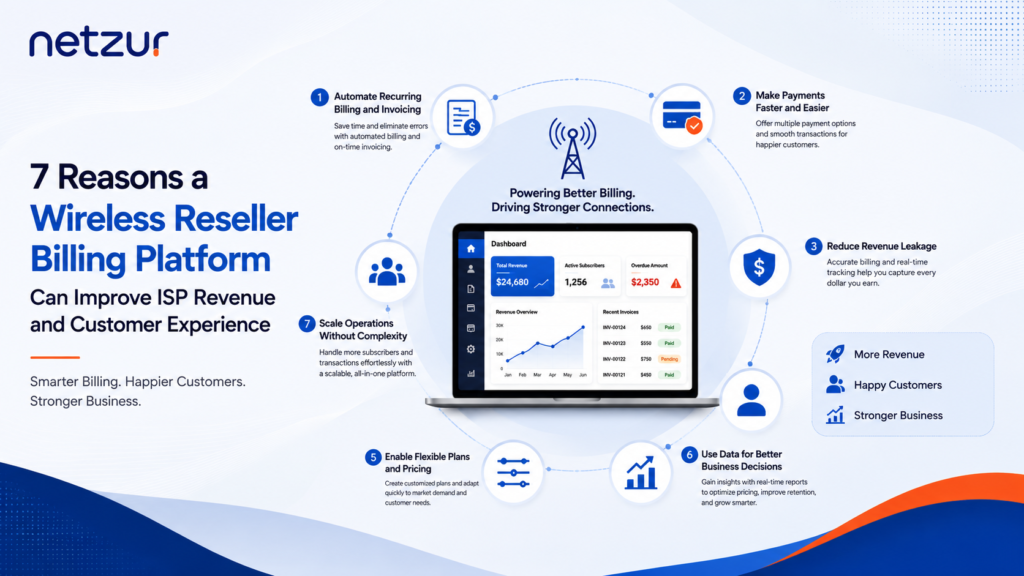
1. Automate Recurring Billing and Invoicing
Manual billing processes can consume significant time and create unnecessary opportunities for human error. A modern wireless reseller billing platform automates recurring invoices based on customer plans, billing cycles, and subscription details.
Instead of manually creating and sending invoices, businesses can automate the entire process. Customers receive accurate bills on schedule, while billing teams spend less time managing repetitive administrative tasks.
Automation can also help reduce missed invoices and billing inconsistencies. With a more predictable billing process, wireless resellers can improve cash flow and maintain better control over their recurring revenue.
Modern billing automation can help businesses manage subscriptions and recurring revenue more efficiently. According to Stripe’s guide to recurring billing, billing solutions can support different pricing models, payment collection, and subscription management.
2. Make Payments Faster and Easier
A complicated payment process can lead to delayed payments and frustrated customers. Today’s subscribers expect convenient ways to pay their internet or wireless bills without unnecessary steps.
A modern billing platform can integrate online payment options and support automated payment workflows. Customers can access their invoices, check outstanding balances, and make payments through convenient digital channels.
Faster payment collection can directly support revenue growth. At the same time, giving customers a simple payment experience can reduce friction and improve overall satisfaction.
3. Reduce Revenue Leakage
Revenue leakage can occur when services are delivered but payments are missed, plans are incorrectly configured, or billing records do not accurately reflect customer usage.
A wireless reseller billing platform can help businesses connect customer accounts, plans, usage information, and billing data in one system. This creates better visibility into what customers are purchasing and what they are being charged.
Automated billing rules can also reduce inconsistencies caused by manual data entry. By improving billing accuracy and monitoring account activity, wireless resellers can identify potential revenue gaps and protect their margins.
For growing providers, even small improvements in billing accuracy can have a meaningful impact on monthly recurring revenue.
4. Improve Customer Self-Service
Customer expectations have changed significantly. Subscribers increasingly prefer solving simple account issues themselves instead of waiting for customer support.
A modern billing platform can provide customers with access to a self-service portal where they can view invoices, check payment status, manage account details, and review their subscription information.
This creates a more convenient customer journey while reducing the number of routine billing questions handled by support teams.
Self-service is particularly valuable for growing wireless resellers because it allows businesses to support more subscribers without increasing customer service workloads at the same rate.
5. Enable Flexible Plans and Pricing
Wireless resellers often serve different customer segments with different connectivity requirements. A single billing model may not be suitable for everyone.
A flexible wireless reseller billing platform can make it easier to manage multiple plans, pricing structures, promotional offers, and subscription models. Businesses can create packages based on speed, data allowances, duration, or other service requirements.
This flexibility allows resellers to respond more quickly to changing market demand. They can introduce new plans, test promotional pricing, or create targeted packages without rebuilding their entire billing workflow.
Flexible billing can also improve customer experience by giving subscribers more choices that match their budgets and connectivity needs.
Flexible billing models, including usage-based billing, can help internet service providers create pricing structures that better match customer consumption. Stripe’s overview of recurring payments explains how variable and hybrid billing models can be used for services where charges depend on usage.
6. Use Data to Make Better Business Decisions
Modern billing is no longer just about generating invoices. Billing data can provide valuable insights into customer behavior and business performance.
With centralized reporting and analytics, wireless resellers can monitor important metrics such as revenue trends, payment performance, active subscribers, overdue accounts, and plan adoption.
These insights can help businesses identify opportunities for growth. For example, a reseller may discover that certain plans have high demand or that customers are frequently upgrading to faster packages.
Data-driven decision-making can help businesses optimize pricing, improve retention strategies, and focus resources on the areas with the greatest revenue potential.
7. Scale Operations Without Increasing Complexity
As a wireless reseller grows, managing more subscribers can make billing increasingly complicated. Adding customers should increase revenue – not create an equal increase in manual administrative work.
A scalable wireless reseller billing platform can help automate key processes across billing, payments, customer accounts, and reporting. This allows providers to handle a larger subscriber base while maintaining operational efficiency.
Scalability is especially important in 2026 as connectivity businesses continue adopting cloud-based tools and automated workflows. A system that works for a small customer base should also be capable of supporting future growth.
By reducing repetitive work and centralizing essential billing information, businesses can focus more on improving network services, acquiring new customers, and strengthening relationships with existing subscribers.
How Billing Automation Supports Customer Experience
Revenue growth and customer experience are closely connected. Accurate invoices, convenient payment options, transparent account information, and fast self-service access can all influence how customers perceive their service provider.
When billing processes work smoothly in the background, customers have fewer reasons to contact support about payment errors or account confusion. This can lead to fewer complaints, faster issue resolution, and stronger customer relationships.
For wireless resellers, investing in billing automation is therefore not simply an operational decision. It can become part of a broader strategy for improving customer retention and creating sustainable recurring revenue.
What to Look for in a Wireless Reseller Billing Platform
Before choosing a solution, wireless resellers should consider whether the platform supports their current requirements and future growth plans. Important features may include automated recurring billing, flexible pricing, online payments, customer self-service, usage tracking, reporting, account management, and integration capabilities.
Security and reliability should also be considered, particularly when handling customer and payment information. The ideal solution should simplify operations without creating additional complexity for technical and billing teams.
FAQs
1. What is a wireless reseller billing platform?
A wireless reseller billing platform is a software solution designed to help wireless internet resellers manage subscriber accounts, recurring billing, invoices, payments, plans, and related business operations. It can automate repetitive billing tasks and provide better visibility into revenue and customer accounts.
2. Can a wireless reseller billing platform help increase revenue?
Yes. By automating billing, reducing payment delays, minimizing billing errors, supporting flexible plans, and improving payment collection, a wireless reseller billing platform can help businesses protect revenue and improve recurring income. Analytics can also provide insights that support better pricing and customer retention decisions.
Conclusion
As wireless connectivity markets become more competitive, resellers need technology that can simplify operations while delivering a better subscriber experience. A wireless reseller billing platform can help automate billing, improve payment collection, reduce revenue leakage, support flexible plans, and provide valuable business insights.
For wireless resellers looking to build a more efficient and scalable operation, Netzur offers billing and management solutions designed to support modern ISP and wireless business requirements. By combining automation with better customer account management, businesses can create a stronger foundation for sustainable growth in 2026.