
Internet usage continues to grow as households, businesses, and connected devices demand faster and more reliable connectivity. For Internet Service Providers (ISPs), delivering consistent performance requires more than increasing network capacity. It requires smarter bandwidth allocation, real-time monitoring, and effective traffic control.
This is why bandwidth management software has become an important tool for modern ISPs. The right solution helps providers monitor network utilization, enforce subscriber plans, identify congestion, and improve service quality without relying entirely on manual processes.
In 2026, ISPs need flexible software that connects bandwidth control with subscriber management, authentication, reporting, and network operations. Here are eight essential features to consider when choosing a solution.
What is Bandwidth Management Software?
Bandwidth management software helps ISPs monitor, allocate, and control the available network capacity across subscribers, devices, and services. It enables providers to establish speed policies, monitor usage patterns, and respond to network congestion.
Depending on the platform and network configuration, these tools can also integrate with billing systems, RADIUS authentication, routers, and network monitoring solutions.
8 Essential Features of Bandwidth Management Software
1. Real-Time Bandwidth Monitoring
Real-time monitoring gives network administrators visibility into bandwidth consumption across network interfaces, subscribers, and supported devices.
With usage dashboards and historical graphs, ISPs can identify peak traffic periods, detect unusual consumption, and investigate performance complaints more efficiently.
For example, if several subscribers experience slow speeds during evening hours, administrators can examine utilization data to determine whether congestion is affecting a particular network segment.
2. Intelligent Bandwidth Allocation
Every subscriber does not necessarily require the same bandwidth allocation. A residential customer, a small business, and a premium broadband subscriber may have different service requirements.
Effective bandwidth management allows ISPs to configure speed profiles according to subscription plans and network policies. This helps providers distribute available capacity according to defined service commitments.
Automated policy enforcement also reduces the need for technicians to update subscriber settings manually whenever a plan changes.
3. Quality of Service (QoS) and Traffic Shaping
Quality of Service (QoS) helps network operators manage different traffic classes according to performance requirements. Traffic shaping controls transmission rates to help prevent congestion and maintain predictable traffic flows.
These capabilities are particularly useful when applications have different latency, jitter, or packet-loss requirements.
For example, an ISP may configure policies to support latency-sensitive voice or video services while controlling less time-sensitive bulk transfers. Actual results depend on network capacity, configuration, and where policies are enforced.
Learn more about traffic engineering through the IETF’s Internet Traffic Engineering Principles.
4. Fair Usage Policy (FUP) Management
Fair Usage Policy management enables providers to establish rules for data consumption and service usage.
Depending on the ISP’s plans and contractual terms, policies may include data thresholds, time-based restrictions, or speed adjustments after specified usage limits are reached.
Automated enforcement helps maintain consistent policies across eligible subscribers. Clear communication about these rules is equally important to prevent unexpected service experiences and customer complaints.
5. Subscriber and RADIUS Integration
Bandwidth control becomes more efficient when connected to subscriber management and authentication systems.
Integration with RADIUS can help ISPs associate authentication sessions and supported policy attributes with individual subscriber accounts. This allows providers to apply appropriate service profiles based on their network configuration.
When combined with subscriber records, this integration can simplify account activation, plan changes, and service suspension or restoration workflows.
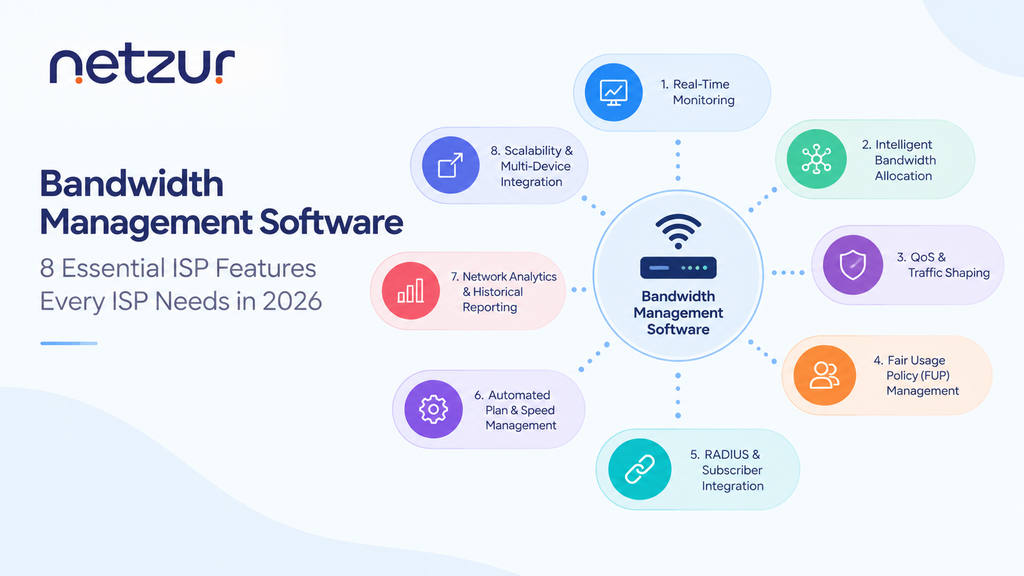
6. Automated Plan and Speed Management
Manual speed changes can become time-consuming as an ISP expands its subscriber base. Automation helps reduce repetitive administrative tasks and minimizes the risk of inconsistent configuration.
Look for software that supports configurable plans, automated service activation, speed-profile updates, and renewal-related workflows.
For example, when a customer upgrades to a higher-speed package, an integrated system can trigger the appropriate policy update, provided the relevant network equipment and integrations support it.
7. Network Analytics and Historical Reporting
Real-time monitoring explains what is happening now, while historical reports help ISPs understand longer-term patterns.
Useful reporting capabilities include:
- Peak bandwidth utilization by time and network segment
- Subscriber-level usage trends
- Traffic growth and recurring congestion periods
- Service performance and operational summaries
- Historical data for capacity planning
These insights help providers make evidence-based decisions about network upgrades, service packages, and resource allocation.
8. Scalability and Multi-Device Integration
An ISP’s software should support business growth without creating unnecessary operational complexity.
Before choosing a platform, evaluate its compatibility with existing routers, Network Access Servers (NAS), authentication systems, and other infrastructure. Check supported integrations, API availability, performance limits, and deployment requirements.
A scalable solution should make it easier to manage additional subscribers and network locations while maintaining consistent policies and centralized visibility.
How to Choose the Right Bandwidth Management Solution in 2026
Start by identifying your biggest operational challenges. These might include peak-hour congestion, manual speed configuration, limited usage visibility, or disconnected subscriber and billing systems.
Next, evaluate each platform against your network architecture and service requirements. Prioritize accurate monitoring, flexible policies, reliable integrations, useful reporting, security, and technical support.
It is also important to distinguish between monitoring and enforcement. A dashboard may identify congestion, but effective control requires compatible network equipment and correctly configured policies.
Conclusion
As broadband demand grows, bandwidth management is becoming essential for ISPs that want to improve network efficiency and deliver consistent subscriber experiences. Real-time monitoring, intelligent allocation, QoS, automation, and analytics help providers make better use of available capacity while simplifying daily operations.
For ISPs looking to connect bandwidth control with subscriber management, billing, and network workflows, Netzur offers ISP management capabilities designed to support more centralized and efficient operations.
FAQs
1. What is bandwidth management software used for?
Bandwidth management software helps ISPs monitor network utilization, allocate bandwidth, configure speed policies, manage traffic, and identify congestion.
2. Why is bandwidth management important for ISPs?
It helps ISPs use network capacity more efficiently, maintain consistent service policies, investigate performance issues, and plan future network upgrades.
3. What is the difference between bandwidth management and traffic shaping?
Bandwidth management is the broader process of monitoring and controlling network capacity. Traffic shaping is a specific technique used to regulate traffic rates and help manage congestion.
4. Can bandwidth management software integrate with ISP billing systems?
Yes. Depending on the platform and available integrations, bandwidth management software can connect with billing and subscriber management systems to coordinate plan changes, usage policies, and account-related workflows.
