
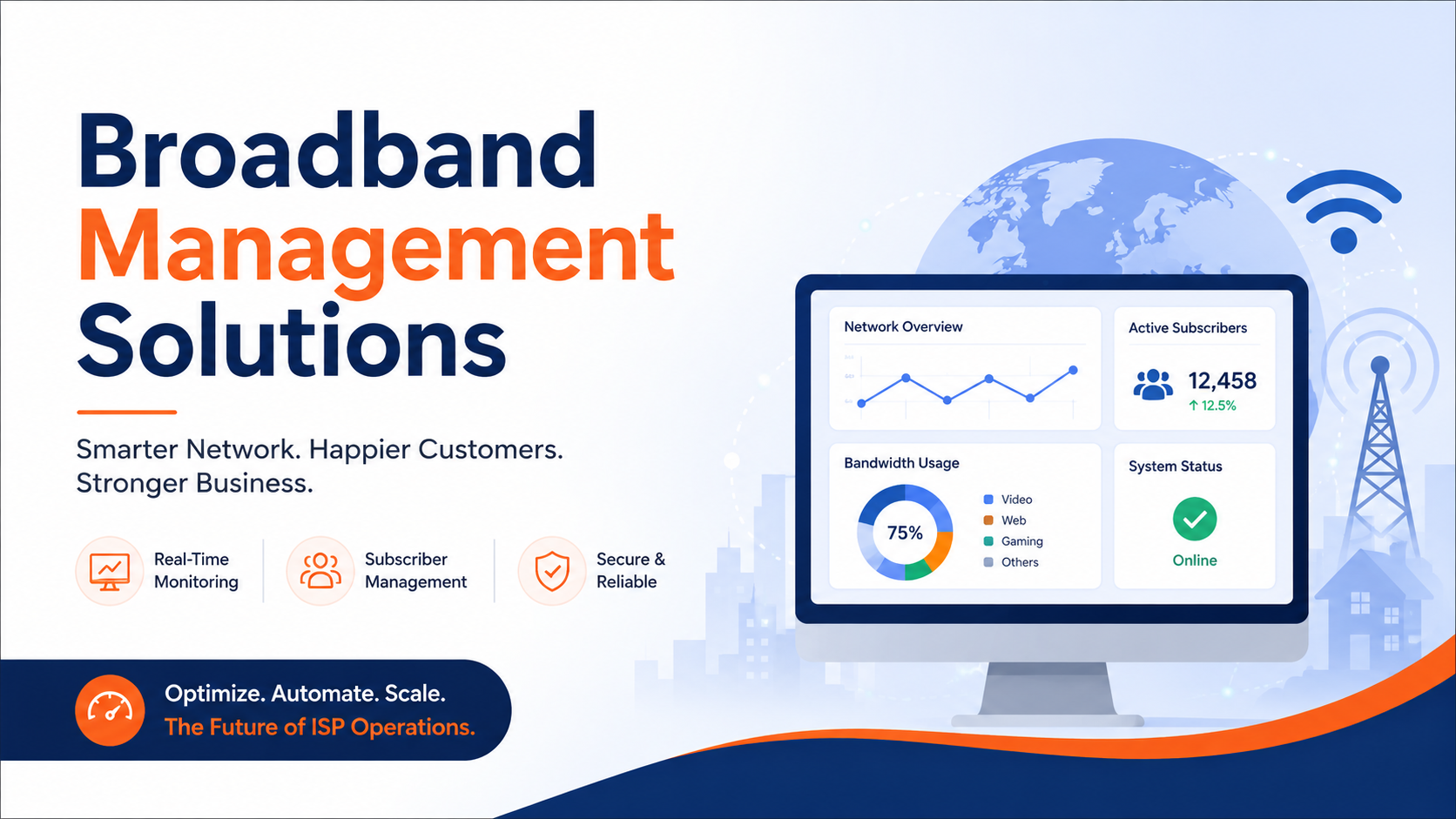
The broadband sector is changing more quickly than before. Internet service providers are constantly under pressure to provide consistent connectivity and flawless customer experiences due to the growth of fibre networks, smart homes, cloud gaming, remote work, and IoT devices. Conventional network management techniques are insufficient in this fiercely competitive environment.
This is where the telecom industry is being transformed by broadband management solutions.
Intelligent solutions that can automate network operations, maximise bandwidth utilisation, monitor user behaviour, decrease downtime, and enhance customer happiness are increasingly necessary for modern ISPs, all while controlling operating expenses. Businesses that implement cutting-edge broadband technology are benefiting greatly in terms of efficiency, scalability, and service quality.
The Significance of Broadband Management Solutions in 2026
Today’s consumers demand uninterrupted, lightning-fast internet. Broadband networks must function smoothly all the time, whether users are using smart gadgets, streaming 4K content, or participating in virtual meetings.
But ISPs frequently encounter difficulties like:
- A rise in network congestion
- Exorbitant operating costs
- Customer attrition as a result of subpar service
- Having trouble overseeing several network nodes
- Unauthorised use and security risks
- Inefficiencies in subscriber management and manual billing
Providers are investing in next-generation broadband management software that integrates analytics, automation, and real-time monitoring into a single platform to address these problems.
By using these methods, network operators can improve subscriber service while streamlining network operations.
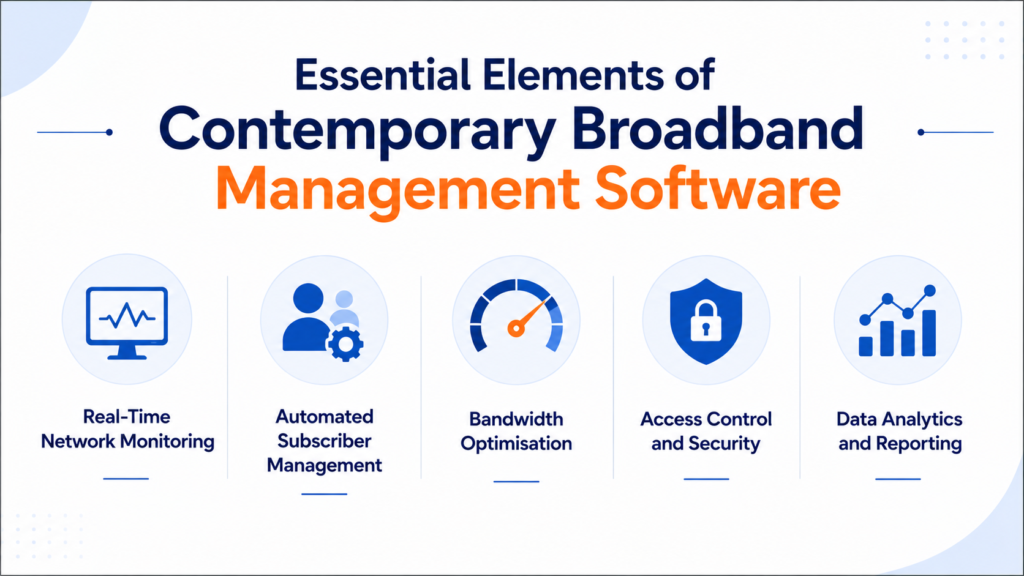
Essential Elements of Contemporary Broadband Management Software
Complex ISP operations are made easier with the help of advanced broadband technologies. The following crucial elements are propelling the sector forward:
1. Network Monitoring in Real Time
To find bottlenecks and avoid downtime, network visibility is essential. Live monitoring dashboards offered by broadband management tools assist operators in quickly identifying problems and preserving network stability.
2. Automated Management of Subscribers
ISP operations may be slowed down by manual customer onboarding and billing procedures. Subscriber activation, plan administration, invoicing, and renewals are made easier by automation solutions.
3. Optimisation of Bandwidth
While reducing congestion during peak hours, efficient bandwidth allocation guarantees equitable consumption across users. Both network performance and user experience are enhanced by intelligent traffic shaping.
4. Access Control and Security
Broadband networks continue to face an increase in cybersecurity risks. To protect ISP infrastructure, modern systems have firewall integration, user authentication, fraud detection, and access control functions.
5. Reporting and Data Analytics
Providers can better understand user behaviour, network consumption trends, and service performance with the aid of analytics technologies. Better business decisions and future network planning are supported by these insights.
The Increasing Need for Managed Internet Services
In order to lower operational complexity and enhance service delivery, several providers are shifting to managed broadband services as broadband networks grow quickly.
With managed services, ISPs can contract with seasoned technical partners to handle network maintenance, monitoring, troubleshooting, and customer support. This strategy guarantees network dependability and operational effectiveness while assisting companies in concentrating on expansion.
Managed broadband services are becoming more and more popular since they provide:
- Reduced expenses for infrastructure management
- Quicker problem solving
- Enhanced uptime of the network
- Availability of professional technical assistance
- Models of scalable deployment
- Improved security and compliance management
Managed services offer enterprise-grade capabilities to small and mid-sized ISPs without the hassle of developing sizable internal technical teams.
How Automation and AI Are Changing Broadband Networks
In broadband infrastructure management, artificial intelligence is emerging as a significant trend. Based on customer demand patterns, AI-powered systems can optimize bandwidth allocation, automate troubleshooting, and forecast failures.
AI-driven networking solutions are anticipated to greatly increase operational efficiency and decrease service interruptions in contemporary telecom ecosystems, according to Cisco.
In a similar vein, broadband automation is assisting providers in transitioning from reactive maintenance to proactive network management. AI systems can detect possible problems before users encounter service disruptions, rather than waiting for problems to arise.
As fibre broadband use continues to rise internationally, this trend is becoming increasingly significant.
Customer Experience is Now the Top Priority
In the broadband market, customer experience has become a major differentiator. Fast internet alone is no longer enough – users expect smooth onboarding, transparent billing, instant support, and consistent connectivity.
A robust broadband management platform helps providers improve customer satisfaction through:
- Faster complaint resolution
- Self-service customer portals
- Automated support workflows
- Real-time usage tracking
- Flexible subscription management
Improved customer experiences directly impact retention rates and long-term revenue growth.
Research from Gartner highlights that organizations investing in customer-centric digital infrastructure are more likely to achieve sustainable growth and operational resilience.
Future Scalability
Scalability is key to the future of broadband. ISPs require infrastructure that can swiftly adjust to the expanding demands of smart cities, 5G networks, IoT ecosystems, and linked devices.
Solutions for scalable broadband management assist providers in:
- Extend services to new areas
- Manage growing numbers of subscribers
- Assist wireless hybrid networks and fibre networks
- Incorporate cloud-based infrastructure
- Shorten the time it takes to launch new services
Companies are better equipped for the digital economy of the future if they invest in scalable technology now.
Selecting the Best Platform for Broadband Management
Network size, subscriber base, scalability needs, automation capabilities, and support services are all important considerations when choosing a platform.
When assessing a solution, suppliers ought to take into account:
- Integration with current systems is simple.
- Compatibility with cloud
- AI and automation capabilities
- Security requirements
- Availability of technical assistance
- Analytics and reporting features
- Scalability and cost effectiveness
Long-term corporate growth can be supported and operational performance can be greatly enhanced by a well-designed broadband management ecosystem.
Final Thoughts
As the broadband industry becomes increasingly competitive, adopting intelligent and scalable broadband management solutions is no longer optional – it is essential for sustainable growth and superior customer experiences.
From automated operations and bandwidth optimization to AI-driven analytics and managed services, modern broadband technologies are helping ISPs transform the way they operate in 2026 and beyond.
Businesses looking to streamline operations, improve service delivery, and future-proof their network infrastructure can explore advanced solutions from Netzur
FAQs
1. What are solutions for broadband management?
Internet service providers may effectively manage network operations, subscriber services, bandwidth allocation, security, and performance monitoring with the aid of software platforms and tools known as broadband management solutions.
2. How may ISP operations be enhanced by broadband management software?
By automating processes like billing, customer onboarding, network monitoring, and traffic management, broadband management software helps ISPs save operating costs and enhance service quality.
3. Describe managed broadband services.
In order to increase network dependability and operational effectiveness, managed broadband services outsource network management, maintenance, and technical support to specialized suppliers.
4. What makes AI crucial for managing broadband networks?
Through cognitive analytics and automation, AI assists broadband providers in anticipating network problems, automating troubleshooting, optimising traffic flow, and enhancing overall operational efficiency.
5. How can solutions for broadband management enhance the user experience?
Faster assistance, real-time monitoring, transparent billing, self-service portals, and reliable internet performance are all ways that these solutions improve the customer experience.
