
Telecom networks are becoming more complex as providers expand fiber, 5G, IoT, cloud services, and high-speed connectivity. Managing these networks manually is no longer efficient. Telecom providers need faster provisioning, real-time visibility, automated workflows, and reliable service management. This is where telecom OSS and network automation are becoming essential.
A modern Operations Support System (OSS) helps telecom companies manage network resources, services, faults, inventory, and operational processes from a connected environment. When combined with automation, OSS can reduce repetitive manual work, improve operational efficiency, and help providers deliver better services at scale.
What Is Telecom OSS?
Telecom OSS refers to the technology systems used by communication service providers to manage and operate their networks and services. It supports critical operational functions such as network inventory, service provisioning, fault management, performance monitoring, and resource management.
Traditional OSS platforms often relied on disconnected systems and manual processes. Modern solutions are increasingly cloud-native, API-driven, data-centric, and designed to work with automated workflows.
This evolution is particularly important as telecom providers manage increasingly dynamic networks involving physical infrastructure, virtualized resources, cloud platforms, and software-defined networking.
Why Network Automation Matters for Telecom
Network automation involves using software, APIs, artificial intelligence, and predefined workflows to perform network-related tasks with minimal human intervention.
For telecom operators, automation can simplify processes that previously required multiple teams and manual approvals. For example, when a customer orders a new service, automated workflows can coordinate service activation, resource allocation, configuration, and validation.
The result is faster service delivery with fewer opportunities for human error.
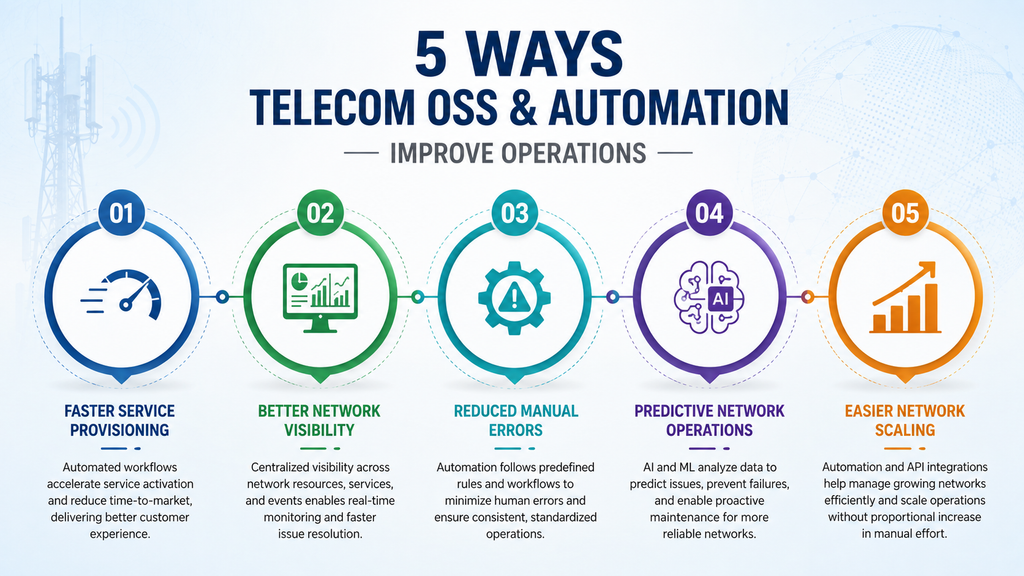
5 Ways Telecom OSS and Automation Improve Operations
1. Faster Service Provisioning
One of the biggest advantages of combining OSS with automation is faster provisioning.
Instead of manually configuring different network components, automated workflows can coordinate the required steps. This allows providers to activate services more quickly and respond to customer requirements with greater agility.
Faster provisioning can also improve the customer experience by reducing waiting times for new connections, upgrades, and service changes.
2. Better Network Visibility
Modern telecom operations require visibility across increasingly distributed infrastructure.
A centralized OSS environment can bring together information about network resources, services, equipment, and operational events. Automation can then use this data to identify conditions that require attention.
Real-time monitoring can help operations teams understand network performance and respond to issues before they significantly affect customers.
3. Reduced Manual Errors
Manual network configuration can introduce inconsistencies and mistakes, particularly when teams manage thousands or millions of services.
Automation allows predefined rules and workflows to perform repetitive tasks consistently. This can reduce configuration errors and create more standardized operational processes.
Teams can therefore spend less time performing routine activities and more time handling complex network issues and strategic initiatives.
4. Predictive Network Operations
Artificial intelligence and machine learning are becoming important components of modern telecom operations.
AI-powered systems can analyze network data to identify unusual patterns, predict potential failures, and support proactive maintenance. Instead of waiting for a service disruption to occur, providers can use operational data to identify risks earlier.
According to IBM’s overview of AI in telecommunications, AI can support telecom use cases including network optimization, customer experience, and predictive maintenance.
This shift from reactive to predictive operations is one of the most important developments shaping telecom OSS.
5. Easier Network Scaling
Telecom networks must continuously scale as subscriber numbers, bandwidth requirements, connected devices, and digital services increase.
Automation enables providers to manage larger environments without increasing manual operational effort at the same rate. API-based integrations can also allow OSS platforms to communicate with network equipment, cloud services, orchestration platforms, and business systems.
This makes the overall infrastructure more flexible and easier to scale.
Telecom OSS Trends Shaping 2026
The evolution of telecom OSS is closely connected to several technology trends.
AI-driven operations: AI is increasingly being used for anomaly detection, predictive maintenance, network optimization, and intelligent decision support.
Cloud-native OSS: Cloud-based architectures can provide greater flexibility and support distributed telecom environments.
API-first integration: APIs allow OSS platforms to communicate with other applications and network systems more efficiently.
Intent-based automation: Instead of specifying every individual configuration step, operators can define the desired network outcome while automation determines how to achieve it.
5G and edge computing: 5G introduces new operational requirements, including dynamic services, network slicing, and distributed infrastructure management.
The TM Forum’s Open Digital Architecture resources highlight the industry’s move toward modular, cloud-based, API-driven telecom architectures.
How to Choose a Modern Telecom OSS
When evaluating an OSS platform, telecom providers should look beyond basic network monitoring. Important capabilities include automation, API integration, real-time monitoring, scalable architecture, service provisioning, network inventory, analytics, and support for modern infrastructure.
Integration is particularly important. An OSS platform should work effectively with existing network equipment and business systems rather than creating another isolated operational environment.
Security, scalability, reporting capabilities, and ease of customization should also be considered before implementation.
The Future of Telecom Operations
Telecom operations are moving toward increasingly automated, intelligent, and software-driven environments. As networks become more complex, relying entirely on manual processes can create operational bottlenecks and increase costs.
A modern telecom OSS provides the foundation for connecting operational data, network resources, services, and automation workflows. When combined with AI, cloud technologies, APIs, and network orchestration, it can help telecom providers build faster and more resilient operations.
For ISPs and telecom businesses looking to modernize their operational infrastructure, solutions such as Netzur can support the transition toward more streamlined and automated network management.
FAQs
1. What is telecom OSS?
Telecom OSS is a set of systems used by telecom operators to manage network resources, services, provisioning, inventory, faults, and network performance.
2. How does network automation work with telecom OSS?
Network automation uses software, APIs, predefined workflows, and increasingly AI to automate operational tasks such as provisioning, configuration, monitoring, and issue detection. This reduces manual effort and helps telecom providers manage networks more efficiently.
