TR069 remains relevant in 2026 because it provides ISPs with a proven way to remotely configure, monitor, troubleshoot, and manage customer-premises equipment (CPE). However, as broadband networks become more advanced, newer technologies such as TR-369, also known as the User Services Platform (USP), are expanding the possibilities of modern device management.
Internet service providers are managing more connected devices than ever before. From fiber ONTs and broadband routers to Wi-Fi gateways and smart home equipment, today’s ISP environment requires efficient tools for provisioning, monitoring, troubleshooting, firmware updates, and remote configuration.
For years, TR069 has been an important technology supporting these requirements. But with the rapid growth of connected homes, IoT devices, cloud-based services, and advanced Wi-Fi ecosystems, an important question is emerging: Is TR069 still relevant in 2026, or is modern device management replacing it?
The answer is more nuanced than simply choosing one technology over another. TR069 continues to provide value for existing broadband infrastructure, while modern approaches such as TR-369 are creating new opportunities for flexible and scalable device management.
What Is TR069?
TR069, formally known as the CPE WAN Management Protocol (CWMP), is a technical specification developed by the Broadband Forum for remotely managing customer-premises equipment.
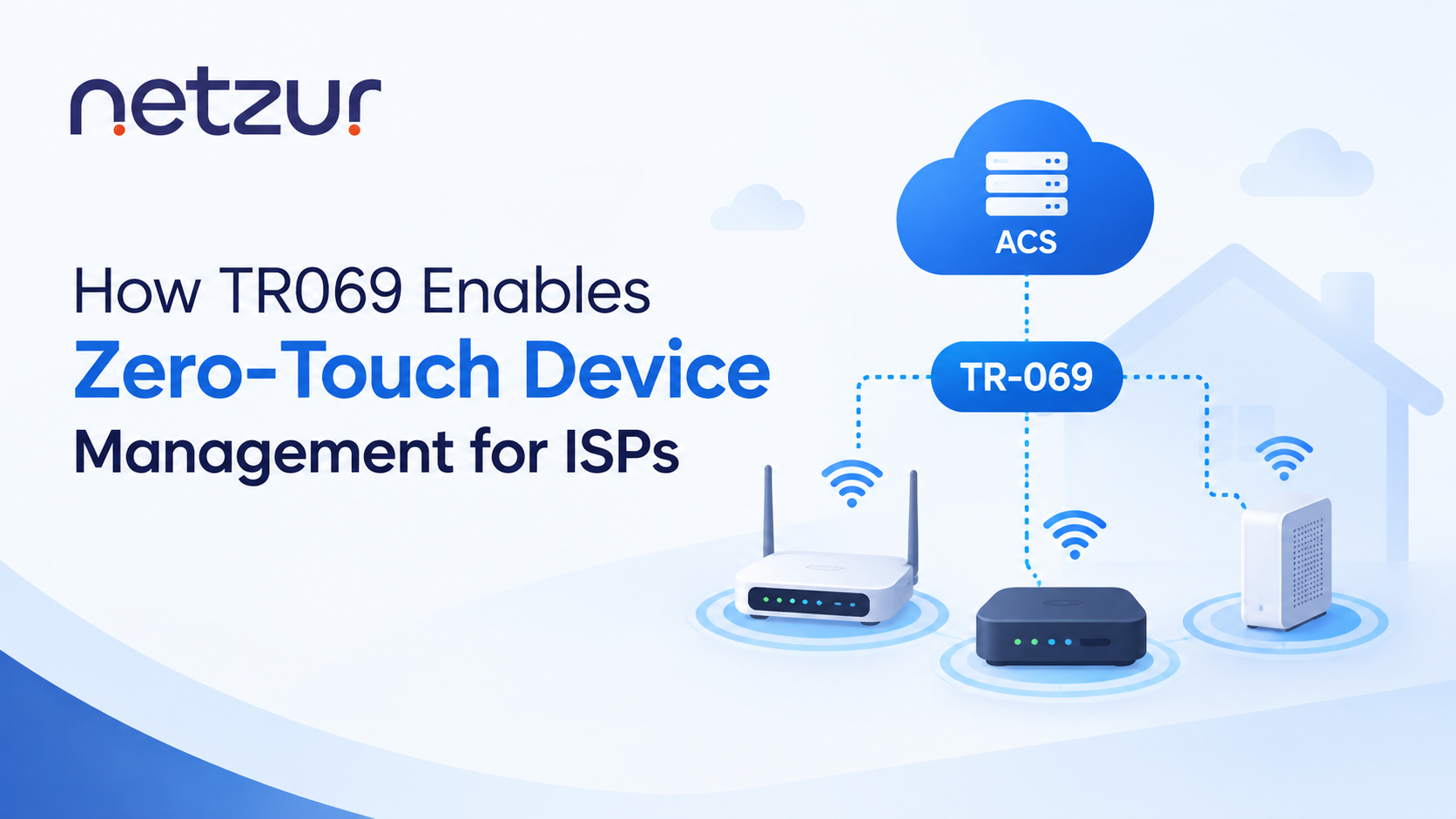
It allows an ISP to communicate with compatible customer devices through an Auto Configuration Server (ACS). This centralized approach enables providers to automate several important device-management tasks without requiring technicians to manually configure every device.
Common TR069 use cases include:
- Automatic device provisioning
- Remote configuration
- Firmware and software updates
- Device monitoring
- Remote diagnostics
- Performance management
- Troubleshooting
- Configuration changes
The Broadband Forum’s TR-069 specification provides the technical foundation for CWMP-based CPE management and remote configuration.
For an ISP managing thousands or even millions of subscribers, centralized device management can significantly reduce manual work. Instead of relying on physical visits for every configuration issue, operators can automate routine processes and remotely access relevant device information.
Why TR069 Still Matters in 2026
Even though TR069 is an established technology, its core purpose remains highly relevant: helping ISPs manage large numbers of customer devices efficiently.
Imagine an ISP with thousands of broadband subscribers. If every router or gateway requires manual configuration whenever a service setting changes, operational costs and support workloads can quickly increase.
A properly implemented TR069 environment can help automate many of these tasks.
1. Automated Device Provisioning
TR069 can enable compatible devices to receive configurations automatically when they connect to the network. This can speed up service activation and reduce manual configuration errors.
2. Remote Troubleshooting
Support teams can remotely collect device information and identify potential configuration problems. In some cases, they can make corrective changes without immediately sending a technician to the customer’s location.
3. Firmware Management
ISPs can manage firmware updates for supported devices, helping maintain consistent software versions and address performance or security requirements.
4. Centralized Device Visibility
An ACS-based management system can give network operators greater visibility into managed CPE. This can help identify recurring problems and improve operational efficiency.
5. Scalable CPE Management
The ability to centrally manage large device fleets makes TR069 particularly valuable for broadband providers with thousands of subscribers and geographically distributed networks.
For these reasons, many ISPs still have strong business reasons to maintain TR069-based infrastructure, especially when they already have a large installed base of compatible equipment.
TR069 vs Modern Device Management
The meaning of modern device management has expanded significantly.
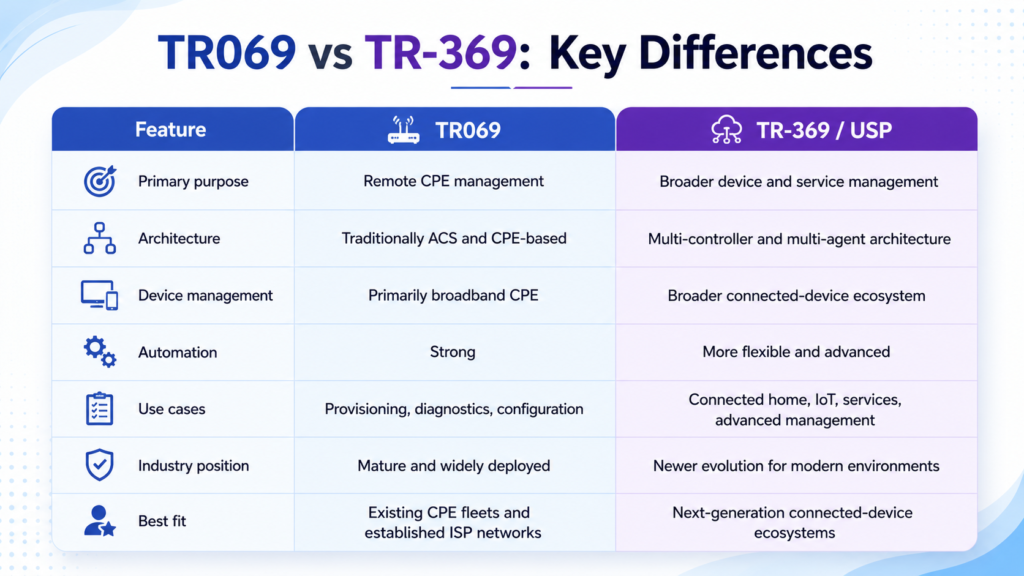
Traditional TR069 deployments typically use an ACS to manage CPE devices. This model works effectively for many broadband environments, particularly where routers, gateways, and ONTs are the primary devices being managed.
Modern connected-home environments, however, are becoming more complex.
ISPs increasingly need to manage not just internet connectivity but also Wi-Fi performance, smart home services, IoT devices, security features, and application-level services. This requires more flexible architectures and broader device-management capabilities.
This is where TR-369 and USP become increasingly important.
The Broadband Forum describes USP as an evolution of TR-069 that extends the concepts of CWMP to support a broader range of connected devices and services. The Broadband Forum’s TR-069 evolution to USP resources provide additional information about this transition.
Is TR069 Being Replaced by TR-369?
The answer depends on the ISP’s infrastructure and long-term strategy.
TR-369, or USP, represents an evolution of the device-management model rather than an immediate requirement for every ISP to replace existing TR069 systems.
Providers with large fleets of TR069-compatible devices may continue using their existing ACS infrastructure while gradually exploring newer technologies. Meanwhile, ISPs building new connected-home platforms may consider USP when they need broader device and service-management capabilities.
The Broadband Forum Technical Library provides current specifications and standards information for organizations evaluating the evolution of broadband device management.
The most practical approach is therefore to evaluate the existing device ecosystem, operational requirements, vendor support, security needs, and future growth plans before deciding on a migration strategy.
What Should ISPs Consider in 2026?
Instead of asking whether TR069 is “dead,” ISPs should ask whether their current device-management architecture can support their future business goals.
A modern ISP device-management strategy should ideally focus on:
- Automated provisioning and configuration
- Remote diagnostics and troubleshooting
- Scalable device management
- Firmware and software lifecycle management
- Better network visibility
- Strong security practices
- Integration with OSS/BSS systems
- Support for multiple device types
- Flexible automation
- A clear migration path for future technologies
For smaller and mid-sized ISPs, continuing to use a reliable TR069 infrastructure may be the most practical choice. For larger providers developing advanced smart-home and IoT ecosystems, adopting or preparing for USP may provide greater flexibility.
The right choice ultimately depends on the provider’s network architecture and business objectives.
The Future of TR069 and ISP Device Management
The future of broadband device management is unlikely to be defined by a single protocol.
TR069 continues to offer a mature and practical solution for managing existing CPE fleets. At the same time, TR-369 and other modern approaches are expanding the capabilities available to operators managing increasingly complex connected environments.
The most successful ISPs will likely adopt a flexible strategy that combines existing infrastructure with future-ready technologies.
Rather than replacing TR069 overnight, the industry is moving toward smarter, more automated, and increasingly comprehensive device management.
This evolution can help providers reduce support costs, improve customer experiences, accelerate service activation, and manage increasingly diverse device ecosystems.
FAQ
1. Is TR069 still relevant in 2026?
Yes. TR069 remains relevant for ISPs managing existing fleets of compatible routers, gateways, ONTs, and other CPE devices. However, newer technologies such as TR-369/USP are becoming increasingly important for advanced connected-home and IoT use cases.
2. What is the difference between TR069 and TR-369?
TR069 uses the CPE WAN Management Protocol and traditionally relies on communication between CPE and an Auto Configuration Server. TR-369, or USP, builds on the concepts of TR069 while providing a more flexible architecture for managing a wider range of connected devices and services.
Conclusion
So, is TR069 still relevant in 2026? Absolutely. While the broadband industry is moving toward more advanced device-management architectures, TR069 remains valuable for ISPs that need reliable and scalable management of existing CPE fleets.
The future is likely to involve a combination of established and emerging technologies, with providers gradually adapting their infrastructure according to their operational needs and long-term goals. For ISPs looking to improve broadband operations, automation, and subscriber management, Netzur provides solutions designed to support modern ISP network and management requirements.