
The internet service industry is evolving rapidly, and customer expectations are higher than ever. From seamless online payments to real-time account management, internet service providers (ISPs) need powerful tools to stay competitive. This is where a modern internet billing system becomes essential.
Gone are the days when billing involved spreadsheets, manual invoices, and delayed payment processing. Today’s providers require intelligent online billing software that automates operations, reduces errors, and improves customer satisfaction.
Whether you’re a startup ISP or an established broadband provider, understanding the key features of a modern billing platform can help you make the right investment. In this guide, we’ll explore the top 10 features every internet billing system should have in 2026.
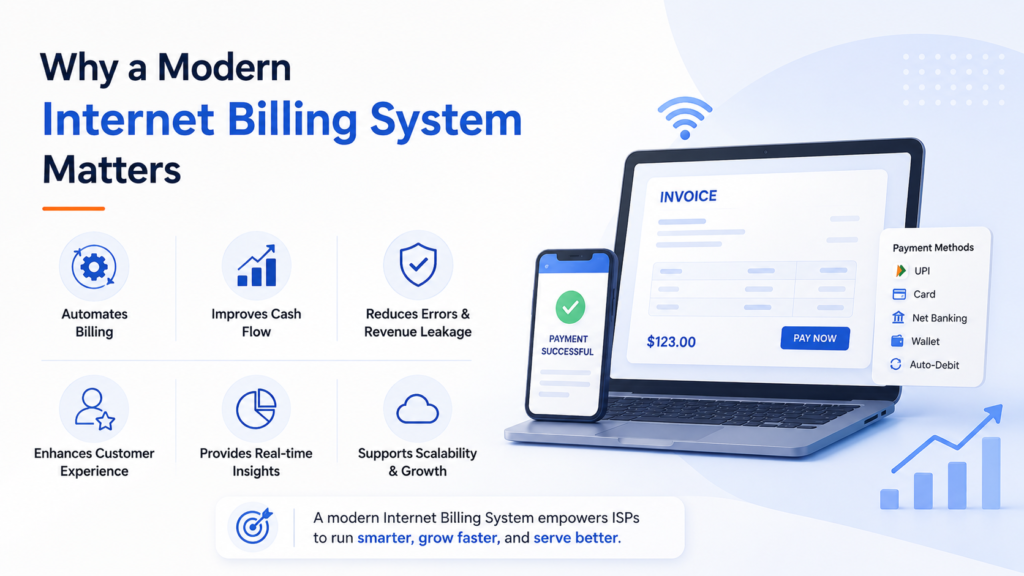
Why a Modern Internet Billing System Matters
An internet billing system is much more than a payment collection tool. It serves as the financial backbone of an ISP by managing subscriptions, invoices, payments, taxes, and customer accounts from a centralized platform.
The right solution helps businesses:
- Automate recurring billing
- Improve cash flow
- Reduce operational costs
- Minimize billing errors
- Enhance customer experience
- Generate real-time financial insights
Let’s look at the features that separate modern billing platforms from outdated systems.
1. Automated Recurring Billing
One of the most important features of any ISP billing software is automated recurring billing.
Customers often subscribe to monthly, quarterly, or annual plans. A modern billing platform should automatically generate invoices and process billing cycles without manual intervention.
Benefits:
- Saves time
- Reduces billing errors
- Improves payment consistency
- Enhances operational efficiency
Automation allows ISPs to focus on growth rather than administrative tasks.
2. Multiple Payment Gateway Integration
Customers expect flexible payment options.
The best online bill pay services for business support various payment methods, including:
- Credit Cards
- Debit Cards
- UPI Payments
- Net Banking
- Digital Wallets
- Auto-Debit Services
Offering multiple payment channels improves customer convenience and reduces payment delays.
3. Customer Self-Service Portal
Today’s customers want instant access to their account information.
A self-service portal enables users to:
- View invoices
- Download receipts
- Update payment methods
- Upgrade service plans
- Track payment history
This reduces support requests while improving the customer experience.
4. Real-Time Billing and Usage Tracking
Modern ISPs often offer plans based on speed, bandwidth, or data usage.
A robust internet billing system should provide real-time tracking of:
- Data consumption
- Active subscriptions
- Payment status
- Service usage
This ensures billing accuracy and transparency for both providers and customers.
5. Flexible Pricing and Subscription Management
Internet providers frequently introduce promotional offers and custom plans.
Modern online billing software should support:
- Monthly plans
- Annual subscriptions
- Usage-based billing
- Discount campaigns
- Bundle packages
- Trial offers
Flexible pricing capabilities help businesses attract and retain customers.
6. Automated Payment Reminders
Late payments can negatively impact cash flow.
A smart billing system automatically sends reminders through:
- SMS
- Mobile Notifications
- Customer Portals
Automated reminders encourage timely payments and reduce outstanding balances.
7. Advanced Reporting and Analytics
Data-driven decisions are critical in 2026.
The best online billing software provides detailed reports on:
- Revenue trends
- Payment collections
- Customer churn
- Subscription growth
- Outstanding invoices
- Profitability metrics
These insights help management optimize business performance and identify growth opportunities.
8. Tax and Compliance Management
Managing taxes manually can be time-consuming and error-prone.
A modern billing solution should automate:
- GST calculations
- VAT management
- Tax reporting
- Regulatory compliance
Automated tax handling reduces risk while ensuring accurate financial records.
For businesses seeking guidance on digital transformation and financial automation, resources from IBM Digital Transformation Insights provide valuable industry perspectives.
9. Cloud-Based Accessibility
Cloud technology has become the standard for modern business software.
Cloud-based ISP billing software offers:
- Remote access
- Automatic updates
- Enhanced security
- Improved scalability
- Reduced infrastructure costs
This allows teams to manage billing operations from anywhere while maintaining business continuity.
Businesses can also explore cloud computing best practices through Amazon Web Services Cloud Computing Guide .
10. CRM and System Integrations
Billing systems should not operate in isolation.
A modern internet billing platform should integrate with:
- CRM Software
- Network Management Systems
- Accounting Platforms
- Payment Gateways
- Customer Support Tools
Integrated systems improve workflow efficiency and eliminate duplicate data entry.
Emerging Trends in Internet Billing Systems
As technology evolves, billing platforms are becoming more intelligent.
AI-Powered Billing Automation
Artificial intelligence helps identify:
- Billing anomalies
- Fraudulent activities
- Revenue leakage
- Payment risk patterns
Predictive Revenue Forecasting
Advanced analytics can predict future revenue trends and customer behavior.
Personalized Billing Experiences
Modern systems allow providers to offer customized plans, discounts, and payment options based on customer preferences.
These innovations are shaping the future of ISP billing and customer management.
How to Choose the Best Online Billing Software
When evaluating billing solutions, consider the following:
- Automated Billing Capabilities
- Multiple Payment Options
- Reporting and Analytics
- Cloud Infrastructure
- Compliance Management
- Customer Self-Service Features
- Scalability
- Third-Party Integrations
Choosing software with these capabilities ensures your business can grow without operational bottlenecks.
Conclusion
A modern internet billing system is no longer optional for internet service providers looking to improve efficiency, customer satisfaction, and revenue management. Features such as automated billing, payment gateway integration, cloud accessibility, analytics, and customer self-service have become essential for success in today’s competitive market.
Businesses looking for a scalable and feature-rich billing platform can explore the advanced solutions available from NetZur Technologies to streamline billing operations and support long-term growth.
FAQs
1. What is an internet billing system?
An internet billing system is software that automates invoicing, payment collection, subscription management, and customer billing processes for internet service providers.
2. Why is automated billing important for ISPs?
Automated billing reduces manual work, minimizes errors, improves payment collection, and ensures a consistent cash flow.
3. What are the benefits of online bill pay services for business?
Online bill pay services simplify payment collection, offer multiple payment methods, improve customer convenience, and reduce overdue invoices.
4. What makes the best online billing software?
The best online billing software includes automation, reporting, payment gateway integration, tax compliance, cloud accessibility, and customer self-service capabilities.
5. Can ISP billing software integrate with CRM systems?
Yes. Most modern ISP billing software integrates with CRM platforms, accounting tools, payment gateways, and network management systems to improve operational efficiency.
