
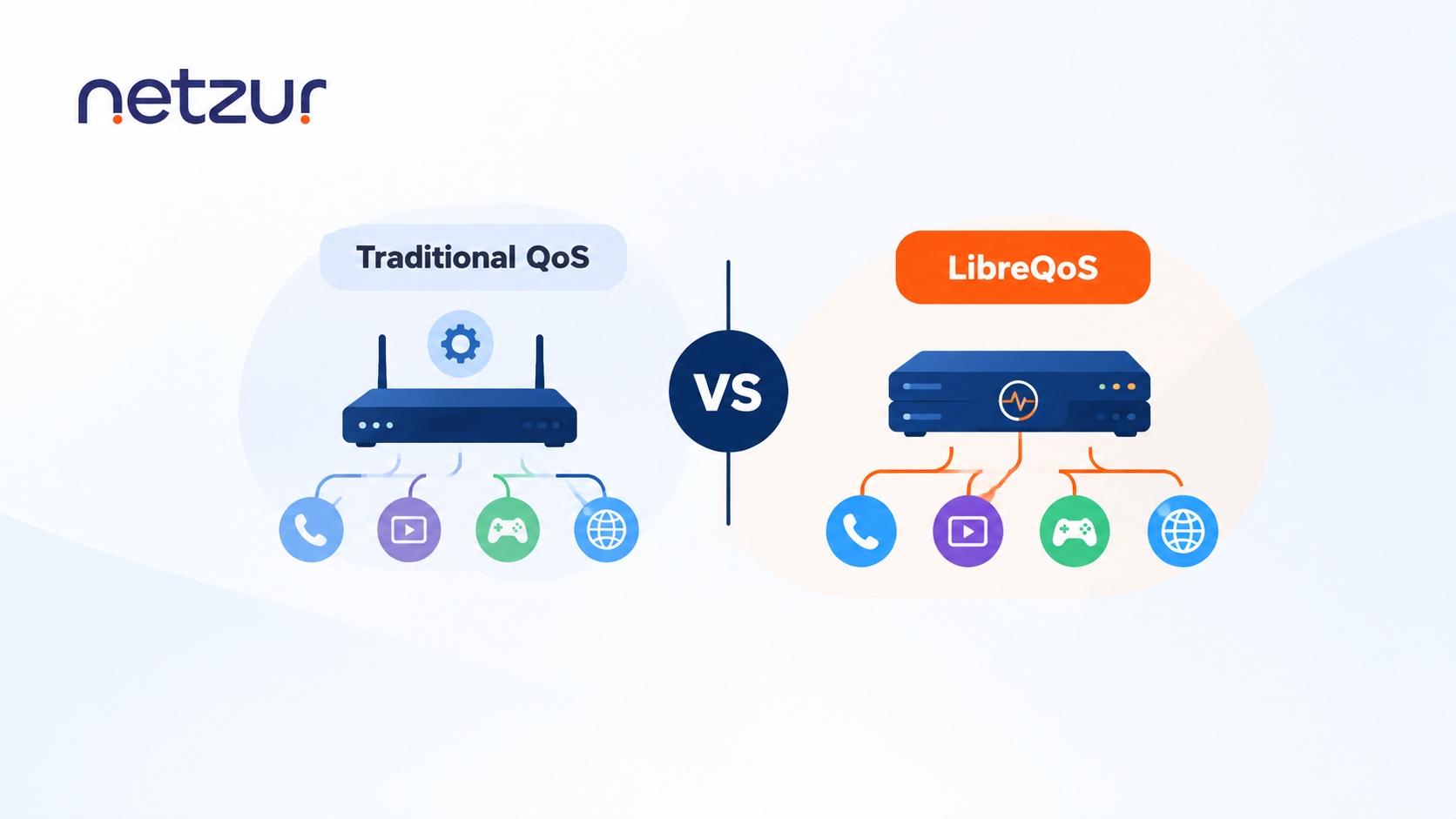
As internet usage continues to grow, Internet Service Providers (ISPs) face increasing pressure to deliver faster, more reliable, and more consistent connectivity. Online gaming, 4K streaming, cloud applications, and video conferencing all require stable network performance, especially during peak hours. Traditional Quality of Service (QoS) techniques help manage network traffic, but modern broadband networks often need more advanced congestion control.
This is where LibreQoS becomes relevant. Designed for ISP networks, LibreQoS combines topology-aware traffic shaping, intelligent queue management, and network visibility to help reduce latency under load. But how does it compare with traditional QoS, and which approach is better for modern ISPs?
What is Traditional QoS?
Traditional Quality of Service (QoS) refers to techniques that manage network traffic according to predefined rules. These rules may prioritize specific applications, classify packets, allocate bandwidth, or limit traffic rates to maintain service quality.
For example, an ISP may prioritize voice traffic over large downloads to help keep calls clear during periods of high network usage. Network administrators can configure policies on routers and switches to control how traffic is handled.
Traditional QoS can be effective for networks with straightforward requirements. However, its effectiveness depends on the equipment, configuration, traffic classification methods, and congestion management techniques being used. Basic prioritization alone may not prevent latency from increasing when a shared network link becomes overloaded.
What is LibreQoS?
LibreQoS is an open-source, self-hosted traffic management and network operations platform designed primarily for ISPs and enterprise networks. It helps operators manage subscriber bandwidth, reduce bufferbloat, and investigate performance issues across their network.
Unlike a simple network-wide bandwidth limit, LibreQoS can model an ISP’s topology, including shared backhaul links, sites, access points, optical line terminals (OLTs), and individual subscriber circuits. This allows operators to apply traffic shaping at relevant points in the network.
LibreQoS uses technologies such as CAKE and FQ-CoDel-based queue management to help manage competing traffic flows and reduce excessive latency during congestion. Its monitoring tools also help operators investigate throughput, round-trip time (RTT), retransmissions, and queue conditions.
According to the official LibreQoS documentation, the platform can operate as a managed bridge between an edge router and the rest of the network, allowing ISPs to introduce traffic management without replacing their entire network infrastructure.
LibreQoS vs. Traditional QoS: Key Differences
Understanding the differences helps ISPs select an approach that matches their network architecture and operational goals.
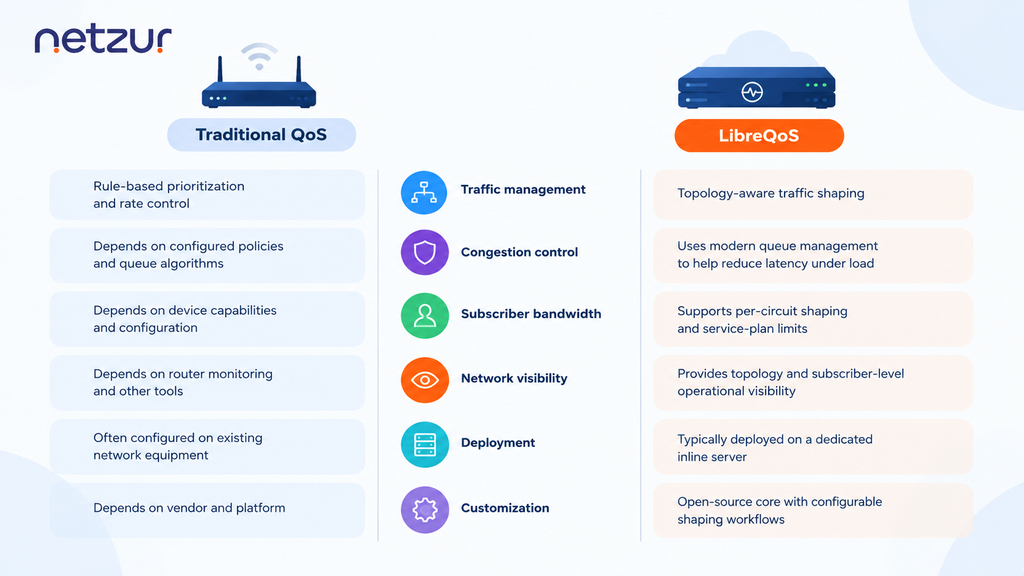
The main distinction is not that traditional QoS is ineffective. Rather, LibreQoS offers a more integrated approach to traffic shaping and operational visibility for ISPs that need to manage congestion across multiple network layers.
5 Reasons Modern ISPs Should Consider LibreQoS
1. Better Control Over Network Congestion
Congestion can develop at a backhaul connection, wireless access point, or shared fiber segment. LibreQoS allows operators to represent these shared-capacity points in a network hierarchy and apply appropriate limits.
This helps contain congestion within an affected branch instead of allowing one overloaded segment to negatively affect the wider network.
2. Reduced Latency and Bufferbloat
High download speeds do not always guarantee a responsive connection. When queues become excessively full, latency can rise, affecting online gaming, video calls, and interactive applications.
LibreQoS uses modern queue management to help keep connections responsive while traffic is flowing. ISPs should validate the results using measurements from their own networks rather than assuming every deployment will produce identical improvements.
3. Fairer Bandwidth Distribution
Subscribers sharing a constrained link can experience inconsistent performance when traffic demand rises. LibreQoS supports per-circuit shaping and fair queuing, helping manage competing flows within configured bandwidth limits.
This can help ISPs deliver a more consistent experience across different subscription plans.
4. Improved Network Troubleshooting
When customers report slow internet, the cause may be congestion, retransmissions, wireless interference, upstream problems, or a subscriber-side issue.
LibreQoS provides network and circuit-level visibility that can help technicians narrow down potential causes. This evidence-based approach can make troubleshooting more efficient than relying only on general speed-test results.
5. Flexible, Open-Source Deployment
The LibreQoS core is open source, giving ISPs flexibility to evaluate and deploy traffic management according to their operational needs. It can be introduced alongside existing routing equipment, subject to hardware, topology, and configuration requirements.
Before deployment, operators should review the LibreQoS installation and configuration documentation to understand system requirements, network placement, integrations, and validation procedures.
Is LibreQoS Always Better Than Traditional QoS?
Not necessarily. Traditional QoS may be sufficient for smaller networks or environments that need straightforward traffic prioritization and already have capable network equipment.
LibreQoS may be more suitable for growing ISPs managing many subscribers, multiple shared-capacity links, and recurring peak-hour congestion. Its topology-aware design and troubleshooting visibility can be especially useful when operators need to understand where performance problems originate.
However, successful implementation requires accurate network topology data, suitable hardware, correct shaping configuration, and careful testing. LibreQoS also does not replace the need for adequate network capacity, robust routing, or effective subscriber management.
FAQ
1. What is the main difference between LibreQoS and traditional QoS?
Traditional QoS generally relies on configured traffic policies and prioritization. LibreQoS adds topology-aware shaping, modern queue management, and subscriber-level visibility designed for ISP operations.
2. Can LibreQoS reduce internet latency?
LibreQoS can help reduce latency caused by excessive queuing and bufferbloat during congestion. Actual results depend on network design, configuration, hardware, and the location of the bottleneck.
3. Is LibreQoS suitable for fiber and wireless ISPs?
Yes. LibreQoS is designed to support ISP environments, including fiber and wireless networks, where shared-capacity links and subscriber-level traffic management are important.
4. Does LibreQoS replace existing routers?
Not necessarily. It is typically deployed as an inline bridge alongside existing network equipment. ISPs must verify compatibility, hardware requirements, and failover arrangements before deployment.
5. How can ISPs decide whether LibreQoS is right for them?
ISPs should measure peak-hour latency, congestion, subscriber complaints, and link utilization. A controlled pilot deployment can help determine whether topology-aware shaping provides meaningful improvements.
Conclusion
Choosing between traditional QoS and LibreQoS depends on network complexity, subscriber demand, and performance goals. While traditional QoS remains useful for basic traffic policies, LibreQoS provides a more integrated approach to congestion management, bandwidth shaping, and subscriber-level troubleshooting.
For ISPs looking to connect network performance with broader billing and subscriber management workflows, Netzur offers ISP-focused software capabilities that can complement an efficient network operations strategy. Combining appropriate network management tools with reliable infrastructure helps providers work toward better connectivity and a more consistent customer experience.
