
Running a broadband business involves much more than providing internet connectivity. Internet service providers need to manage subscribers, plans, invoices, payments, authentication, service activation, support requests, and network resources every day. As subscriber bases grow, handling these processes manually can create delays, errors, and unnecessary operational workload.
This is where ISP billing software is becoming an important part of modern broadband operations. In 2026, billing platforms are increasingly moving beyond invoice generation to connect financial processes with subscriber management, network systems, automation, and customer service.
Why Broadband Operations Are Becoming More Complex
Modern ISPs operate across multiple technologies, locations, plans, and customer segments. A single provider may need to manage fiber customers, wireless subscribers, business connections, prepaid plans, recurring subscriptions, and different bandwidth packages.
At the same time, broadband networks are becoming more complex and data-intensive. Broadband Forum has highlighted the industry shift toward interoperable, automated, and intelligent network platforms that can bring different systems and technologies together.
Traditional spreadsheets and disconnected applications can make these workflows difficult to manage. Teams may need to move information between billing, CRM, network management, payment, and support systems. An integrated approach can reduce this fragmentation.
How ISP Billing Software Simplifies Daily Operations
1. Automated Invoice Generation
One of the most important advantages of ISP billing software is automated invoicing. Instead of preparing invoices manually for every subscriber, businesses can configure billing cycles, plans, discounts, taxes, recurring charges, and other billing rules.
Automation can help reduce repetitive administrative work while making billing schedules more consistent. Modern platforms can also support different billing models, including recurring, prepaid, postpaid, usage-based, and pro-rata billing.
2. Faster Payment Tracking
Payment management is another area where automation can make daily operations easier. A centralized system can connect invoices with payment records and help teams monitor outstanding balances.
Automated reminders can also notify customers about upcoming or overdue payments. When payment status is connected with subscriber services, providers can create workflows for suspension and reconnection based on configured business rules.
This reduces the need for staff to repeatedly check individual accounts and manually update service status.
3. Better Subscriber Management
Billing information is closely connected to subscriber information. Modern ISP billing software can provide a centralized customer profile containing information such as service plans, payment history, account status, usage information, and service details.
Having these details available in one place can help customer support and operations teams respond more efficiently.
Customer portals can further allow subscribers to view invoices, check account information, make payments, and manage selected services without contacting support for every request.
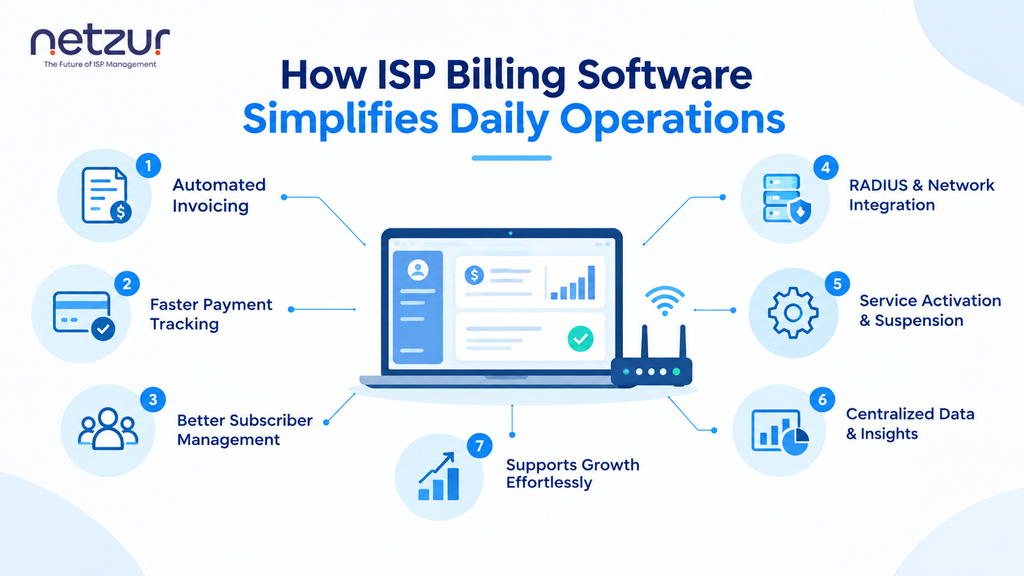
4. Integration With RADIUS and Network Systems
Billing should not operate separately from the network. For many ISPs, subscriber authentication and access control are closely connected with billing status.
Integration with RADIUS or AAA infrastructure can allow billing and subscriber information to work alongside authentication and authorization processes. Network-management platforms commonly connect billing with technologies such as RADIUS, SNMP, TR-069, APIs, and other network systems.
For example, when a subscriber changes plans, the relevant service information can be reflected across connected systems according to the provider’s configured workflow.
This creates a more connected operational environment instead of requiring teams to update multiple systems separately.
5. Simplified Service Activation and Suspension
Manual service activation can take time, particularly when an ISP is managing hundreds or thousands of subscribers.
With automation, workflows can be created around events such as:
- New subscriber registration
- Plan activation
- Plan upgrades
- Payment confirmation
- Account suspension
- Service reconnection
- Bandwidth changes
Automation can help reduce repetitive tasks and provide more consistent service handling.
Cisco’s current service-provider guidance similarly emphasizes automation, observability, and integrated network operations as ways to simplify service delivery and manage growing operational complexity.
6. Centralized Data for Better Decision-Making
Another important benefit is operational visibility. Instead of relying on separate spreadsheets and disconnected applications, teams can use centralized information to understand subscriber growth, revenue, outstanding payments, service plans, and other operational metrics.
This can help managers identify trends and make more informed decisions about pricing, network expansion, customer support, and service offerings.
As broadband networks become increasingly data-driven, having connected operational information becomes more valuable.
7. Supporting Growth Without Adding More Manual Work
Scalability is a major consideration for growing ISPs. Adding subscribers should not mean adding the same amount of manual administrative work.
A well-integrated billing platform can automate repetitive processes while supporting larger subscriber databases, additional plans, multiple locations, and different payment workflows.
The objective is not simply to process more invoices. It is to create operational workflows that can handle growth with greater consistency.
The Future of ISP Billing Software
In 2026, ISP billing software is increasingly becoming part of a broader operational ecosystem rather than functioning as an isolated finance tool. Automation, network integration, subscriber self-service, analytics, and API connectivity are shaping how providers manage their businesses.
The growing focus on intelligent and automated broadband operations also reflects the industry’s wider move toward software-driven service delivery. Broadband Forum’s 2026 work highlights the importance of interoperability and automation in managing increasingly complex broadband environments.
For ISPs planning their next stage of growth, the key consideration is therefore not only whether software can generate invoices, but whether it can connect billing with the wider subscriber and network lifecycle.
Conclusion
As broadband operations become more complex, ISP billing software can help providers reduce repetitive work, centralize subscriber information, automate billing processes, and connect financial workflows with network operations. In 2026, the broader direction is toward unified and automated ISP management rather than disconnected tools.
Solutions such as Netzur are designed around this connected approach, helping ISPs bring billing, subscriber management, CRM, and network-related workflows into a more centralized operational environment.
FAQ
1. What is ISP billing software?
ISP billing software is a platform designed to help internet service providers manage subscriber billing, invoices, payments, plans, account status, and related operational processes.
2. What features should ISP billing software have?
Important features can include automated invoicing, payment management, subscriber management, recurring billing, RADIUS/AAA integration, service activation, notifications, reporting, CRM integration, and customer self-service.
3. Can ISP billing software integrate with RADIUS?
Yes. Many modern ISP management platforms support RADIUS or AAA integration, allowing subscriber authentication and billing-related workflows to work together.
4. How does ISP billing software help growing ISPs?
Automation can reduce repetitive administrative tasks, centralize subscriber information, improve payment tracking, and support larger numbers of customers and service plans.
5. Can ISP billing software automate customer suspension and reconnection?
Depending on the platform and its network integrations, providers can configure automated workflows for service suspension, payment confirmation, and reconnection.
