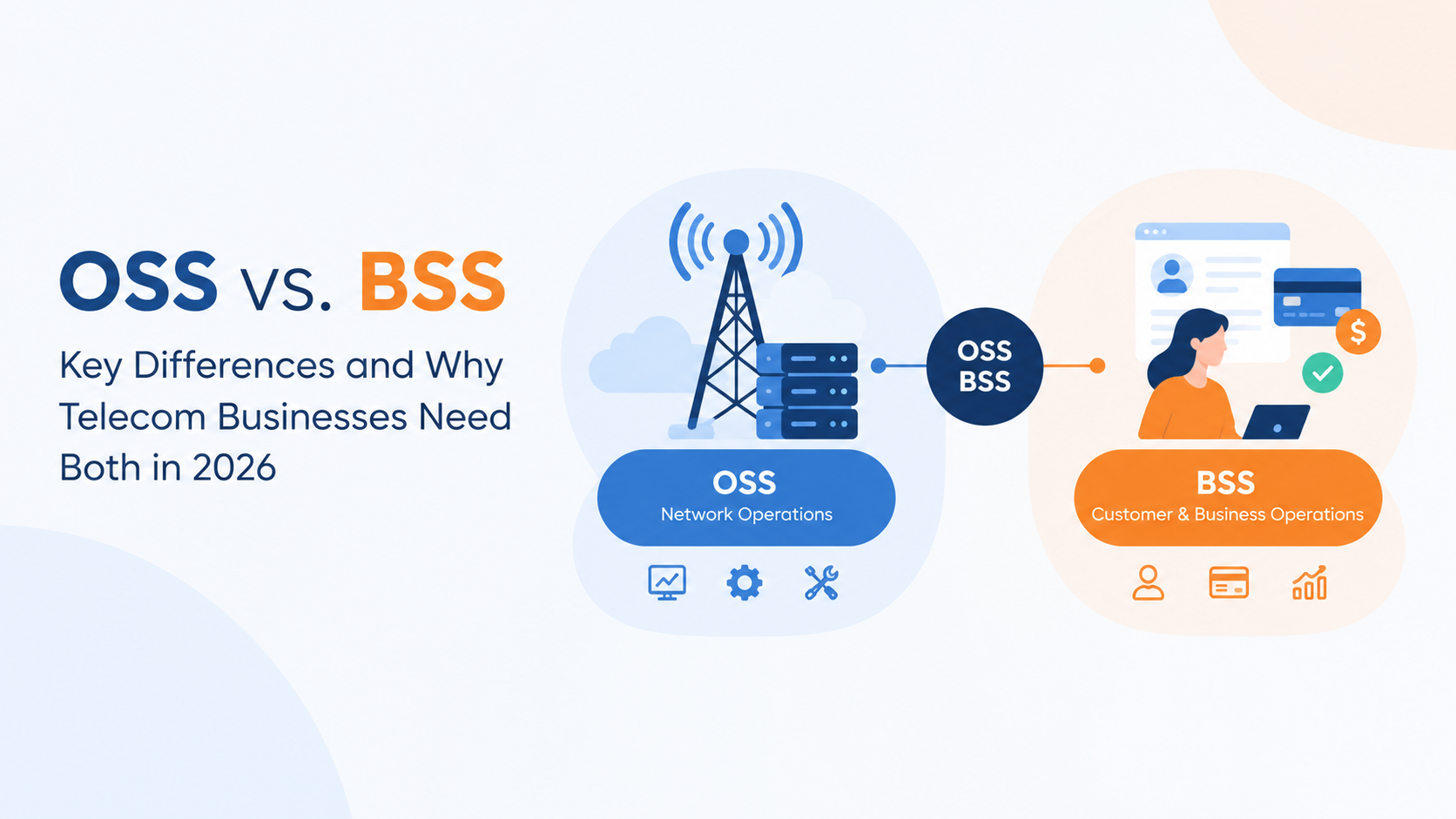
Telecom and internet service providers (ISPs) must manage two essential areas of their business: network operations and customer-facing processes. From monitoring connectivity and activating services to managing subscriptions, billing, and payments, every activity needs to work together seamlessly.
This is where Operations Support Systems (OSS) and Business Support Systems (BSS) become important. Although they serve different purposes, both contribute to efficient service delivery and sustainable business growth.
In 2026, as telecom businesses adopt cloud-based infrastructure, AI-driven automation, and real-time service management, understanding the differences between OSS and BSS is more important than ever. Modern OSS BSS systems help providers connect network performance with customer requirements, improve operational visibility, and deliver more reliable services.
What Are OSS Systems?
Operations Support Systems (OSS) are software solutions that help telecom operators and ISPs manage, monitor, and maintain their network infrastructure. Their primary goal is to ensure that network resources operate efficiently and that services remain available.
Common OSS functions include:
- Network monitoring: Tracks network performance, connectivity, and device status.
- Fault management: Identifies network issues and helps technical teams resolve disruptions.
- Service provisioning: Supports the activation and configuration of internet and telecom services.
- Network inventory: Maintains information about network resources and infrastructure.
- Performance management: Helps providers identify bottlenecks and optimize network capacity.
For example, when an ISP installs a new broadband connection, OSS-related processes can help configure the necessary network resources and activate the service.
By automating repetitive technical tasks, OSS reduces manual intervention and helps providers maintain service quality as their networks grow.
What Are BSS Systems?
Business Support Systems are software solutions that manage customer-facing and commercial activities. They help telecom providers handle customer relationships, subscriptions, billing, payments, and service packages.
Key BSS functions include:
- Customer relationship management (CRM): Organizes customer information and interactions.
- Billing and invoicing: Calculates charges and generates customer bills.
- Subscription management: Tracks active services, plans, and renewals.
- Order management: Processes customer requests for new connections or plan changes.
- Payment management: Records payments and supports account reconciliation.
For example, when a customer subscribes to a broadband package, BSS can record the order, assign the selected plan, maintain billing details, and track payments.
Effective BSS processes help providers simplify administration, improve customer service, and maintain accurate revenue records.
OSS vs. BSS: Key Differences
Although OSS and BSS work toward the same business objective, their responsibilities differ.
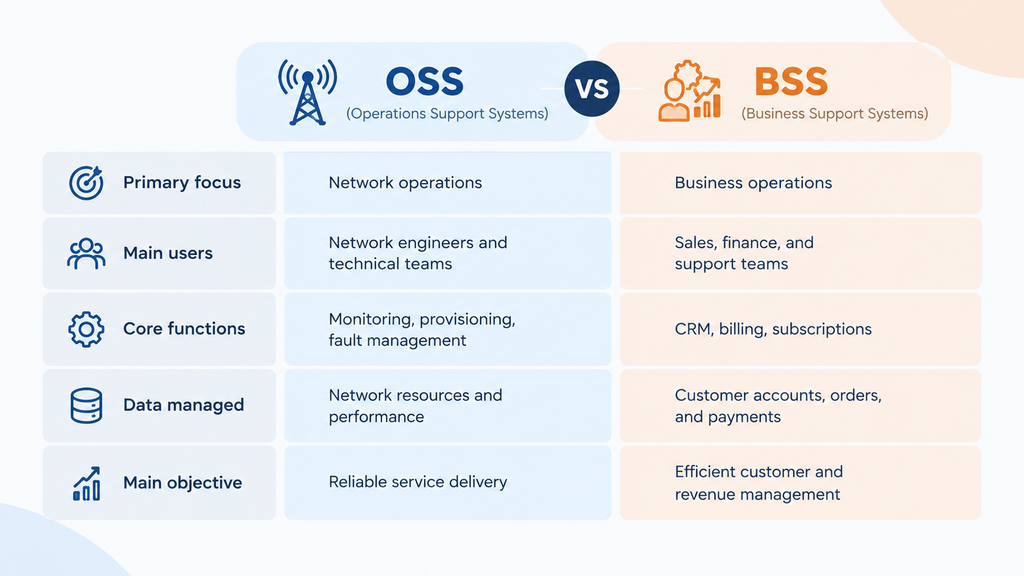
The simplest way to understand the difference is that OSS helps manage how a service operates, while BSS manages the commercial relationship surrounding that service.
However, this distinction is not always absolute. Modern telecom platforms increasingly connect functions across both areas to support end-to-end service management.
Why Telecom Businesses Need Both in 2026
1. Faster Service Activation
Customers expect new internet connections and plan upgrades to happen quickly. When BSS order management connects with OSS provisioning, providers can reduce manual handoffs between sales and technical teams.
This integration helps move a customer request from order placement to service activation more efficiently.
2. Better Billing Accuracy and Revenue Control
Billing problems can arise when customer plans, service status, and network activation records do not match. Integrated systems help synchronize these records, reducing the risk of incorrect invoices and unbilled active services.
This is particularly valuable for ISPs managing multiple packages, recurring subscriptions, and large customer bases.
3. Improved Network Visibility and Customer Support
When a network issue occurs, technical teams need to identify the affected infrastructure, while customer support teams need to understand which subscribers may be impacted.
Connected OSS and BSS workflows can help teams share relevant information faster, improve incident communication, and reduce the time needed to resolve customer complaints.
4. Automation and AI-Ready Operations
Automation is becoming an important part of telecom digital transformation. Integrated systems can support automated service activation, payment-based service suspension, account updates, and incident workflows.
When reliable data is available across business and network systems, AI-assisted analytics can also help teams identify patterns, prioritize problems, and make better operational decisions. The level of automation depends on system capabilities and implementation.
5. Scalable Cloud-Based Infrastructure
As providers expand into new locations and serve more subscribers, disconnected legacy applications can become difficult to maintain.
Cloud-ready, API-enabled architectures can make it easier to integrate applications, exchange information, and introduce new capabilities over time. The TM Forum’s Open Digital Architecture provides guidance for evolving telecom systems toward reusable, cloud-native components.
Read the TM Forum Open Digital Architecture resource to explore modern telecom architecture approaches.
How to Choose the Right OSS BSS Systems
Before selecting a solution, telecom businesses should evaluate their operational requirements, growth plans, and existing infrastructure.
Consider these factors:
- Integration capabilities: Ensure business and network applications can exchange data reliably.
- Automation features: Look for workflows that reduce repetitive manual tasks.
- Billing flexibility: Support the pricing plans, subscription models, and payment processes your business requires.
- Network visibility: Choose suitable monitoring, fault management, and provisioning capabilities.
- Scalability: Ensure the platform can accommodate additional subscribers and services.
- Security and access control: Protect customer information and restrict access according to user responsibilities.
Providers should also review implementation costs, migration requirements, technical support, and reporting capabilities before making a decision.
For additional industry guidance, explore the TM Forum’s BSS/OSS Cloudification Guide.
FAQ
1. What is the main difference between OSS and BSS?
OSS focuses on network operations, including monitoring, fault management, and service provisioning. BSS focuses on customer and commercial activities, including billing, subscriptions, CRM, and payments.
2. Can telecom businesses operate without OSS or BSS?
Some businesses may use simpler or combined software platforms instead of separate OSS and BSS products. However, they still need suitable capabilities for network management, customer administration, and revenue operations.
3. How do OSS BSS systems work together?
BSS typically captures customer orders and commercial requirements, while OSS supports the technical processes needed to deliver the service. Integration helps synchronize service activation, account information, billing, and support workflows.
4. Are cloud-based OSS BSS systems suitable for ISPs?
Cloud-based solutions can be suitable for ISPs seeking flexible infrastructure, easier integration, and scalable operations. Suitability depends on security requirements, network architecture, costs, and the provider’s operational needs.
Conclusion
OSS and BSS serve different but complementary roles in telecom operations. OSS helps maintain network reliability, while BSS manages customer relationships, subscriptions, and revenue processes. Together, they enable more connected, efficient, and scalable service delivery.
As automation and cloud-based operations continue to shape the telecom industry in 2026, choosing integrated OSS BSS systems can help ISPs reduce manual work and improve visibility across their businesses. Netzur offers ISP-focused capabilities for managing billing, subscribers, network operations, and related workflows, helping providers work toward more streamlined operations.