Modern business networks are becoming more complex than ever. Cloud applications, hybrid infrastructure, remote users, IoT devices, AI workloads, and distributed offices have created an environment where traditional network monitoring alone may no longer be enough.
For years, businesses relied on monitoring tools to check whether routers, switches, servers, and other network devices were operational. While this approach remains useful, the growing complexity of IT infrastructure is pushing organizations toward more proactive solutions.
This is where networking management software is gaining importance.
Unlike traditional monitoring, which primarily focuses on identifying problems, modern network management platforms aim to provide broader visibility, automation, performance optimization, centralized control, and faster troubleshooting. In 2026, businesses are increasingly looking for tools that can help IT teams move from reactive problem-solving to proactive network operations.
So, what is the difference between networking management software and traditional network monitoring, and which approach is better for modern businesses?
What is Traditional Network Monitoring?
Traditional network monitoring is primarily designed to observe network infrastructure and alert administrators when something goes wrong.
These tools typically track metrics such as:
- Device availability
- CPU and memory utilization
- Bandwidth consumption
- Network latency
- Packet loss
- Interface status
- Server performance
- Traffic patterns
Monitoring systems often use technologies such as SNMP, ICMP, and NetFlow to collect information from network devices.
The main goal is simple: detect problems and notify the IT team.
For example, if a router becomes unavailable or bandwidth usage crosses a predefined threshold, the monitoring system sends an alert. An administrator then investigates the issue and takes corrective action.
This approach works well for smaller or relatively simple environments. However, modern networks can generate enormous volumes of data across cloud, on-premises, wireless, edge, and remote environments. According to IBM, traditional monitoring methods can struggle with the scale and speed of data generated by modern networks, increasing the need for more intelligent monitoring and automation.
According to IBM, AI-powered network monitoring can help analyze real-time telemetry, identify anomalies, support predictive analysis, and provide remediation guidance.
What is Networking Management Software?
Networking management software takes a broader approach to network operations.
Instead of simply asking, “Is the network working?”, modern management platforms help answer questions such as:
- Why is network performance declining?
- Which devices or users are affected?
- Where is the bottleneck?
- Can routine tasks be automated?
- How can network resources be optimized?
- What problems are likely to occur next?
- How can administrators manage multiple devices from one interface?
The focus shifts from basic monitoring to visibility, control, automation, and optimization.
Depending on the platform, networking management software may include centralized dashboards, device management, configuration management, bandwidth monitoring, performance analytics, automated workflows, reporting, alerts, and integrations with other IT systems.
This makes it particularly valuable for businesses managing large or distributed networks.
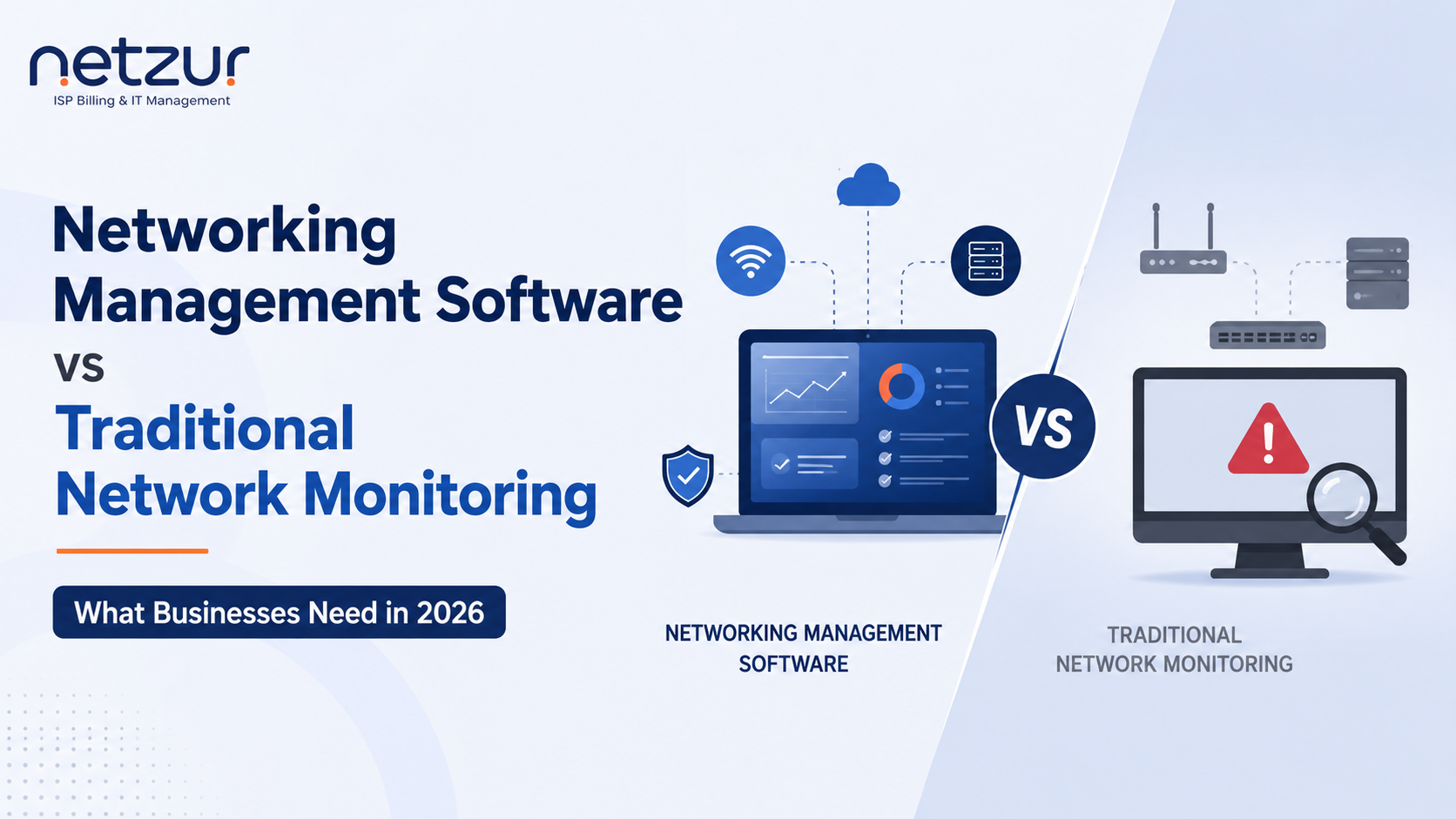
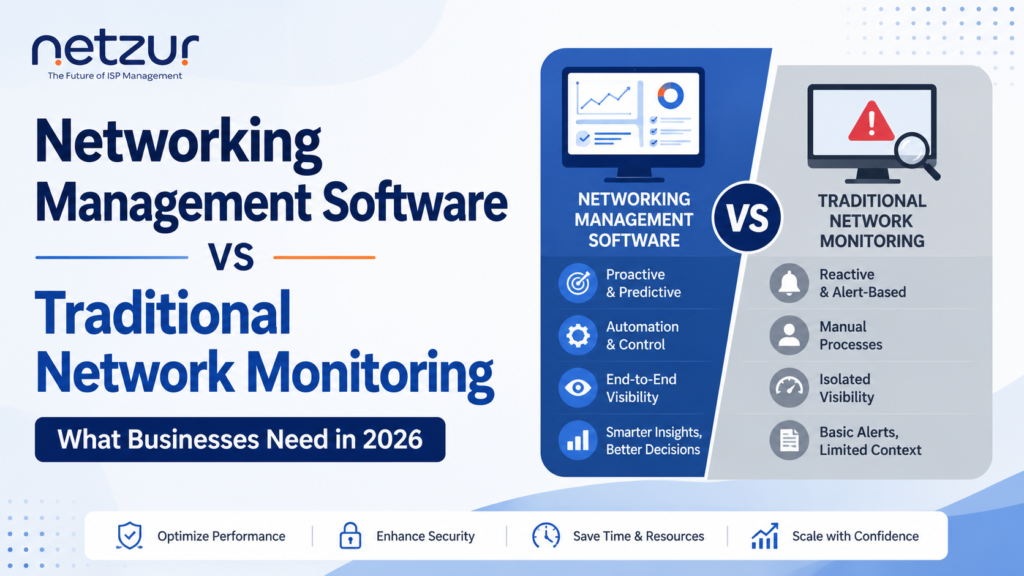
Networking Management Software vs Traditional Network Monitoring
The biggest difference is the scope of what each solution is designed to accomplish.
1. Reactive vs Proactive Operations
Traditional monitoring is often reactive. It identifies an issue after a threshold has been crossed or a device has failed.
Modern networking management software can take a more proactive approach by analyzing network data, identifying unusual patterns, and helping teams detect potential issues earlier.
AI-powered monitoring is accelerating this shift. IBM explains that AI-based network monitoring can analyze real-time telemetry, identify anomalies, support predictive analysis, and provide remediation guidance.
2. Alerts vs Actionable Insights
Traditional monitoring can generate large numbers of alerts. While alerts are important, an IT team may still need to manually investigate the root cause.
Modern management platforms aim to provide more context around an issue.
Instead of simply reporting that a device is experiencing high latency, an advanced platform may help administrators understand the affected services, identify related network events, and determine where corrective action should begin.
This can reduce troubleshooting time and improve operational efficiency.
3. Manual Management vs Automation
Manual configuration becomes increasingly difficult as networks expand.
Networking management software can help automate repetitive activities, standardize configurations, and simplify the administration of multiple devices.
In 2026, automation is becoming a central part of network strategy. Cisco’s current networking trends highlight the growing importance of autonomous workflows, centralized visibility, and AI-driven operations for simplifying network management.
4. Device-Centric vs Network-Wide Visibility
Traditional monitoring often focuses heavily on individual devices.
Modern management platforms aim to provide a broader view across the network, helping administrators understand relationships between devices, users, applications, locations, and services.
This is increasingly important as businesses adopt hybrid cloud environments and distributed infrastructure.
5. Fixed Rules vs AI-Assisted Intelligence
Traditional systems typically depend on predefined thresholds and rules.
Newer platforms are increasingly incorporating AI and machine learning to identify anomalies and recognize patterns that may not be obvious through static rules.
The goal is not necessarily to eliminate human expertise but to give network teams better information and faster ways to respond.
Why Businesses Are Moving Toward Modern Network Management
The shift toward networking management software is being driven by several major trends.
AI adoption is increasing network traffic and infrastructure demands. Cisco reported in 2026 that organizations are already experiencing or anticipating network capacity constraints as AI-driven workloads expand.
Hybrid and distributed environments are also making centralized visibility more important. Businesses may have employees, applications, cloud services, branch offices, and connected devices operating across different locations.
At the same time, IT teams are under pressure to accomplish more with limited resources. Automation can reduce repetitive administrative work and allow technical teams to focus on strategic improvements.
Security is another major consideration. A centralized view of network activity can help organizations identify unusual behavior and respond more quickly to potential risks.
Cisco’s research on 2026 networking trends highlights the growing importance of autonomous workflows, centralized visibility, and AI-driven operations for simplifying network management.
Which Solution Should Businesses Choose?
The answer depends on the size and complexity of the network.
Traditional monitoring may still be sufficient for a small organization with a limited number of devices and straightforward infrastructure.
However, businesses managing multiple locations, cloud environments, large user bases, or complex infrastructure may benefit from a more comprehensive networking management software approach.
The ideal solution should offer:
- Centralized network visibility
- Real-time performance monitoring
- Automated alerts and workflows
- Device and configuration management
- Bandwidth and traffic analysis
- Scalability for future growth
- Strong reporting and analytics
- Integration with existing infrastructure
- AI-assisted insights where appropriate
- Security and access controls
The goal should not simply be to collect more network data. It should be to turn network data into useful decisions and faster actions.
The Future of Network Management in 2026 and Beyond
The future of network operations is moving toward intelligent, automated, and increasingly autonomous infrastructure.
As AI, cloud computing, edge technologies, and connected devices continue to grow, organizations will need better ways to manage increasingly complex environments.
Networking management software is therefore evolving from a simple administrative tool into an operational platform that can combine monitoring, analytics, automation, and centralized control.
Businesses that continue relying exclusively on manual processes and isolated monitoring tools may find it increasingly difficult to maintain performance and scalability.
The most effective strategy is likely to combine reliable monitoring with intelligent management, automation, human oversight, and strong security practices.
FAQs
1. Is networking management software better than traditional network monitoring?
Not necessarily in every situation. Traditional monitoring remains useful for basic infrastructure visibility and alerts. However, networking management software generally provides broader capabilities, including centralized management, automation, analytics, and proactive troubleshooting. Businesses with complex or growing networks may benefit more from a comprehensive management approach.
2. Can networking management software use AI?
Yes. Modern platforms may integrate AI and machine learning for anomaly detection, predictive insights, automated troubleshooting, and network optimization. However, capabilities vary by solution. Businesses should evaluate whether AI features provide practical value, explainable insights, and appropriate human oversight rather than choosing a platform based on AI branding alone.
Conclusion
The difference between traditional network monitoring and networking management software is becoming increasingly important in 2026. Monitoring helps businesses understand what is happening, while modern management platforms aim to help them understand why it is happening and what they can do next.
As networks become more distributed, AI-driven, and complex, organizations need solutions that combine visibility, automation, analytics, and control. For businesses looking to modernize network operations, Netzur provides solutions designed to simplify network and subscriber management while supporting more efficient and scalable operations.