The internet service provider (ISP) industry is becoming increasingly competitive in 2026. Customers expect reliable connectivity, transparent billing, quick technical support, and seamless service activation. At the same time, ISPs must manage growing subscriber bases, recurring payments, network operations, and customer relationships without increasing administrative workloads.
This is where subscriber management software becomes essential. It helps internet service providers centralize customer information, automate routine tasks, monitor subscriptions, and improve operational efficiency. However, not every platform offers the same capabilities.
Choosing the right solution requires understanding which features can support business growth, simplify daily operations, and deliver a better customer experience.
1. Centralized Subscriber Database
A centralized subscriber database is the foundation of effective subscriber management. Instead of maintaining customer details across spreadsheets and disconnected applications, ISPs can manage essential information from a single platform.
Look for features that support:
- Customer profiles and contact details
- Active and inactive subscriptions
- Internet packages and plan history
- Installation addresses and service status
- Account activity and payment records
A unified database helps teams access accurate information quickly, reduce duplicate records, and resolve customer queries more efficiently. It also creates a reliable foundation for billing automation and customer analytics.
2. Automated Billing and Payment Management
Billing errors and delayed payments can affect cash flow and customer satisfaction. Modern subscriber management software should simplify recurring billing and reduce the need for manual intervention.
Important capabilities include automated invoice generation, payment tracking, outstanding balance monitoring, and payment reminders. Integration with digital payment gateways can make it easier for customers to pay their bills on time.
ISPs should also look for configurable billing cycles, flexible internet packages, discounts, and support for different payment methods.
Automation can help reduce administrative work while making billing processes more consistent. When payment and subscription records are connected, staff can quickly identify overdue accounts and take appropriate action.
3. CRM and Customer Lifecycle Management
Customer relationship management (CRM) helps ISPs manage the complete subscriber journey, from the first enquiry to service activation, renewal, and support.
A strong platform should include lead tracking, onboarding workflows, customer communication history, and follow-up reminders. These features help sales and support teams coordinate their work without switching between multiple tools.
For example, when a new customer requests a broadband connection, the system can track feasibility checks, documentation, installation, and activation. This reduces delays and provides better visibility into each stage.
Effective CRM integration also helps ISPs identify renewal opportunities and understand why customers may discontinue their subscriptions.
4. Real-Time RADIUS and Network Integration
In 2026, subscriber management should connect customer accounts with network access and service policies. Integration with RADIUS (Remote Authentication Dial-In User Service) allows compatible systems to manage authentication, authorization, and usage accounting.
Look for support for:
- RADIUS and AAA authentication
- Network Access Server (NAS) integration
- PPPoE and supported access protocols
- Bandwidth and data usage monitoring
- Automatic application of subscriber plans
When integrated correctly, these capabilities help ISPs connect subscription status with network access rules. For instance, a plan upgrade can trigger the appropriate service-policy update, subject to network configuration and permissions.
Network integration reduces manual configuration and helps maintain consistent service delivery as subscriber numbers grow.
5. Automated Notifications and Service Controls
Automation is one of the most valuable features of modern subscriber management software. It helps ISPs handle repetitive tasks consistently while keeping subscribers informed.
Useful automation capabilities include payment reminders, renewal alerts, registration confirmations, and notifications about service changes. Systems can also support automatic suspension of overdue accounts and service restoration after successful payment, according to configured policies.
These workflows reduce repetitive administrative work and help prevent avoidable service interruptions. ISPs should ensure that automated actions have appropriate safeguards, clear records, and exception-handling options.
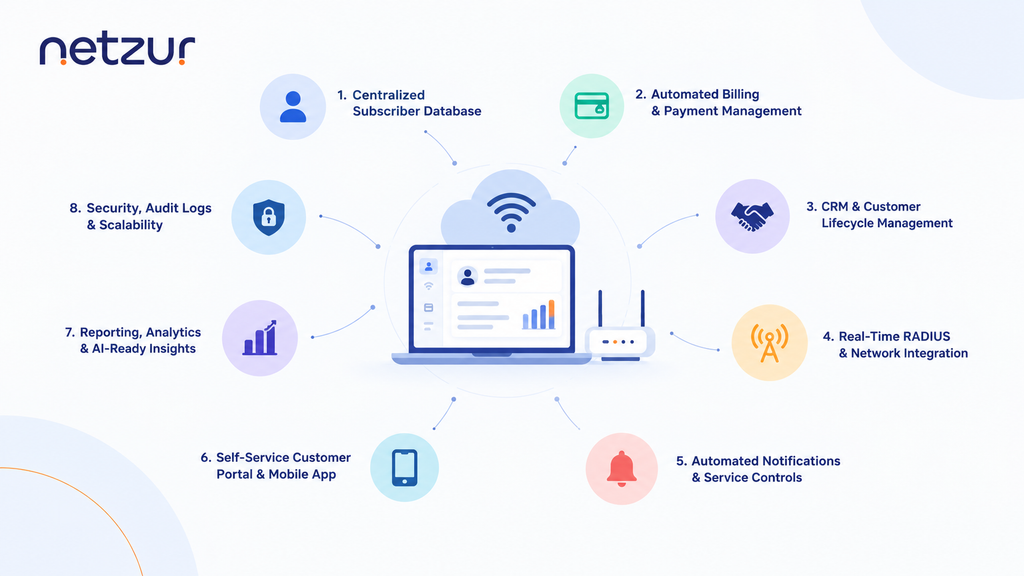
6. Self-Service Customer Portal and Mobile App
Customers increasingly expect to manage their internet accounts without contacting support for every request. A self-service portal or mobile application can improve convenience while reducing pressure on customer service teams.
Essential features include:
- Online bill payments and recharge options
- Current plan and usage information
- Invoice and transaction history
- Support ticket creation and tracking
- Plan renewal and account notifications
When subscribers can resolve routine issues independently, support teams can focus on more complex technical problems. A mobile-friendly interface is particularly useful for customers who prefer managing their accounts through smartphones.
7. Reporting, Analytics, and AI-Ready Insights
Data-driven decision-making is becoming increasingly important for growing ISPs. Reporting tools help operators understand subscriber growth, revenue trends, overdue payments, service demand, and support performance.
Look for customizable dashboards, downloadable reports, historical comparisons, and filters by location, plan, or subscriber status.
AI-assisted analytics can add value by identifying unusual patterns, highlighting potential churn risks, or helping teams investigate operational questions. However, these capabilities should be evaluated based on data quality, transparency, access permissions, and practical business outcomes rather than marketing claims alone.
8. Security, Audit Logs, and Scalability
Subscriber records contain personal and commercial information, making security essential. Choose software with role-based access controls, secure authentication, reliable backups, and detailed audit logs.
The NIST Cybersecurity Framework provides guidance for managing cybersecurity risks and strengthening organizational security practices.
Scalability matters just as much. Your software should support additional subscribers, service areas, franchisees, and integrations without requiring a complete system replacement.
For operators serving the US market, the FCC broadband transparency requirements are also worth reviewing when designing customer-facing plan information and service disclosures.
FAQ
1. What is subscriber management software for ISPs?
Subscriber management software helps internet service providers manage customer profiles, subscriptions, billing, service activation, payments, and support through a centralized system.
2. Which features are most important in subscriber management software?
The most important features include centralized subscriber records, automated billing, CRM, RADIUS integration, payment notifications, customer self-service, reporting, and security controls.
3. How does subscriber management software improve ISP efficiency?
It automates repetitive administrative tasks, connects customer and billing records, improves visibility into subscriber activity, and helps teams resolve requests more efficiently.
4. Can subscriber management software support business growth?
Yes. Scalable software can help ISPs manage larger subscriber bases, multiple service locations, additional packages, and more complex workflows without relying entirely on manual processes.
Conclusion
Selecting the right subscriber management software in 2026 means looking beyond basic customer records. ISPs should prioritize automation, billing accuracy, CRM, network integration, self-service tools, analytics, security, and scalability to build more efficient operations.
For ISPs seeking an integrated approach to subscriber management, billing, CRM, and network operations, Netzur offers an ISP management platform designed to bring these essential workflows together. Explore the available features at Netzur to evaluate how the platform aligns with your business requirements.