Wi-Fi has moved far beyond simply providing internet access. Businesses, hotels, campuses, and Internet Service Providers (ISPs) now depend on wireless networks for cloud applications, IoT devices, digital services, customer experiences, and everyday operations. As networks become more complex, traditional on-site Wi-Fi management can make monitoring, troubleshooting, and scaling increasingly difficult.
This is where cloud WiFi solutions are becoming an important part of modern network infrastructure.
With centralized management, remote monitoring, automated configuration, analytics, and stronger security capabilities, cloud-managed Wi-Fi gives organizations greater visibility and control without requiring every network function to be managed locally.
What Are Cloud WiFi Solutions?
Cloud WiFi solutions are network management systems that allow Wi-Fi infrastructure to be configured, monitored, and controlled through a cloud-based platform.
Instead of relying entirely on physical controllers at each location, administrators can manage access points, users, policies, performance, and connected devices through a centralized interface.
This approach is particularly useful for businesses operating multiple branches, hotels, educational institutions, retail locations, and growing ISP networks.
Modern cloud Wi-Fi platforms can also integrate with authentication systems, analytics tools, security platforms, and other network technologies, creating a more connected approach to network management.
Why Cloud WiFi Is Trending in 2026
The shift toward cloud-managed networking is being accelerated by several developments.
Enterprise WLAN spending continued to grow strongly in 2026, while Wi-Fi 7 has become a major part of new enterprise deployments. IDC reported that Wi-Fi 7 represented 53% of enterprise dependent access-point revenue in Q2 2026, reflecting growing demand for higher performance and modern wireless infrastructure.
At the same time, businesses are increasingly using cloud applications, AI-powered services, IoT devices, and distributed work environments. These technologies require networks that can be monitored and optimized continuously rather than managed only when problems occur.
5 Key Benefits of Cloud WiFi Solutions
1. Centralized Network Management
One of the biggest advantages is centralized control.
Network administrators can manage multiple access points, locations, users, and policies from a single cloud dashboard. This reduces the need to configure every device individually and makes it easier to maintain consistent network policies.
For organizations with multiple branches or properties, centralized management can significantly simplify daily network operations.
2. Remote Monitoring and Troubleshooting
Cloud-based management allows IT teams to monitor network performance remotely.
Administrators can identify issues such as disconnected access points, unusual traffic, weak connectivity, or device problems without being physically present at the location.
This can reduce troubleshooting time and help teams respond to network issues faster.
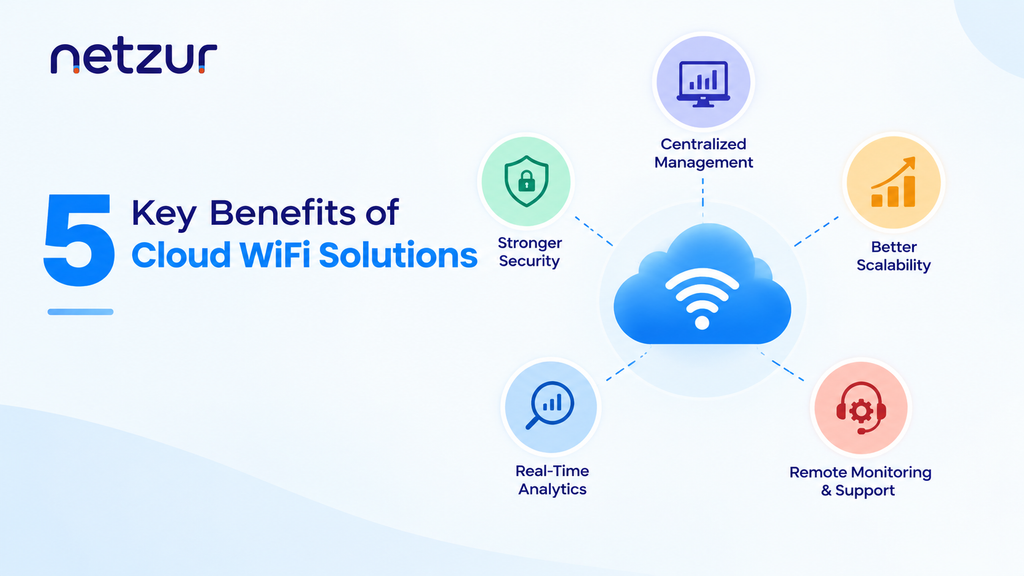
3. Better Scalability
Traditional network infrastructure can become difficult to manage as an organization expands.
Cloud WiFi solutions make it easier to add new access points, users, locations, and services while maintaining centralized control. This is particularly valuable for businesses with multiple offices, hotel properties, retail branches, or distributed networks.
Cloud management can also support zero-touch or simplified provisioning, allowing new network equipment to be deployed with less manual configuration.
4. Improved Visibility and Analytics
Modern Wi-Fi management is increasingly data-driven.
Cloud platforms can provide visibility into connected devices, network usage, performance trends, traffic patterns, and potential connectivity issues. This information helps administrators understand how networks are being used and where improvements may be required.
Analytics can also support capacity planning by showing which locations or access points experience the highest demand.
5. Stronger Security and Policy Control
Security is another major reason organizations are moving toward modern cloud-managed networks.
Businesses need to manage an increasing number of employee devices, guest devices, IoT equipment, and cloud applications. Modern wireless infrastructure can support stronger authentication, segmentation, access controls, and security policies.
For example, WPA3 is increasingly important for modern wireless environments, while Wi-Fi 7 platforms are designed with enhanced security capabilities. Cisco highlights the growing importance of wireless security as businesses deploy AI, IoT, hybrid work, and customer-facing applications.
Cloud WiFi and Wi-Fi 7: A Powerful Combination
Wi-Fi 7 is one of the most important developments shaping wireless infrastructure in 2026.
Its capabilities are designed for environments that require higher throughput, lower latency, and better performance in dense environments. However, upgrading access points alone is not enough.
Organizations also need effective management.
Combining Wi-Fi 7 infrastructure with cloud-based monitoring and management can give IT teams greater visibility into modern wireless networks. This becomes especially useful when businesses need to manage multiple locations or large numbers of connected devices.
The combination of high-performance wireless infrastructure and centralized cloud management is likely to become increasingly important as businesses adopt AI applications, smart devices, video services, and other bandwidth-intensive technologies.
Cloud WiFi for Hotels, ISPs, and Multi-Site Businesses
The use cases for cloud WiFi solutions extend across multiple industries.
For hotels, reliable Wi-Fi supports guest connectivity, smart-room technology, digital check-in, entertainment, and operational systems. Hospitality technology trends in 2026 increasingly connect Wi-Fi with AI, IoT, cloud platforms, and personalized guest experiences.
For ISPs, cloud-based management can help simplify network visibility, subscriber connectivity, authentication, and service operations.
For multi-site businesses, centralized management makes it easier to maintain consistent configurations and monitor network performance across locations.
What to Look for in a Cloud WiFi Solution
Before selecting a platform, businesses should evaluate more than just wireless speed.
Important capabilities include:
- Centralized cloud management
- Remote monitoring and troubleshooting
- Scalable multi-site support
- User and device management
- Authentication and access control
- Network analytics
- Security and policy management
- Wi-Fi 6/6E and Wi-Fi 7 compatibility
- Integration with existing network infrastructure
- Automated configuration and provisioning
- Reliable reporting and performance visibility
The right solution should support both current requirements and future network expansion.
The Future of Cloud WiFi Solutions
Cloud WiFi is becoming part of a broader shift toward intelligent, automated networking. Network teams increasingly expect infrastructure to provide real-time visibility, proactive monitoring, stronger security, and simplified operations.
As AI, IoT, Wi-Fi 7, cloud applications, and distributed businesses continue to grow, wireless networks will become even more important to everyday operations.
The future is not simply about faster Wi-Fi. It is about creating networks that are easier to manage, more secure, more scalable, and capable of adapting to changing business requirements.
For organizations planning their next network upgrade, cloud WiFi solutions can provide a practical foundation for building a more connected and future-ready infrastructure.
FAQ
What are cloud WiFi solutions?
Cloud WiFi solutions are platforms that allow organizations to manage, monitor, configure, and optimize wireless networks through a cloud-based management system.
Are cloud WiFi solutions suitable for multi-location businesses?
Yes. Centralized cloud management is particularly useful for organizations operating multiple offices, branches, hotels, campuses, or other locations because administrators can manage network infrastructure from a single platform.
Are cloud WiFi solutions secure?
They can provide advanced security features such as authentication, access controls, network segmentation, monitoring, and modern wireless security standards. However, security also depends on proper configuration and overall network architecture.
Can cloud WiFi support Wi-Fi 7?
Yes. Modern cloud-managed platforms can support Wi-Fi 7 infrastructure, depending on the specific platform and hardware. Wi-Fi 7 adoption is growing rapidly in enterprise networking.
How can cloud WiFi help ISPs?
Cloud-based Wi-Fi management can improve network visibility, simplify remote administration, support subscriber and device management, and help ISPs operate networks across multiple locations more efficiently.
Conclusion
As businesses become increasingly dependent on connected services, wireless infrastructure needs to be more intelligent and manageable than ever. Cloud WiFi solutions provide centralized control, remote visibility, scalability, analytics, and modern security capabilities that can help organizations manage increasingly complex networks.
For businesses and ISPs looking to modernize their connectivity infrastructure, Netzur offers a broader network management approach designed to support evolving connectivity and operational requirements.