The internet service provider (ISP) industry is changing rapidly. Growing customer expectations, increasingly complex networks, rising operational costs, and new AI-driven technologies are pushing providers to rethink how they manage their businesses.
In 2026, ISP management software is evolving beyond basic subscriber management and billing. Modern platforms are increasingly focused on automation, real-time intelligence, cloud operations, predictive insights, and better customer experiences.
For ISPs looking to remain competitive, understanding these emerging trends can help identify the technologies and capabilities that will matter most in the years ahead.
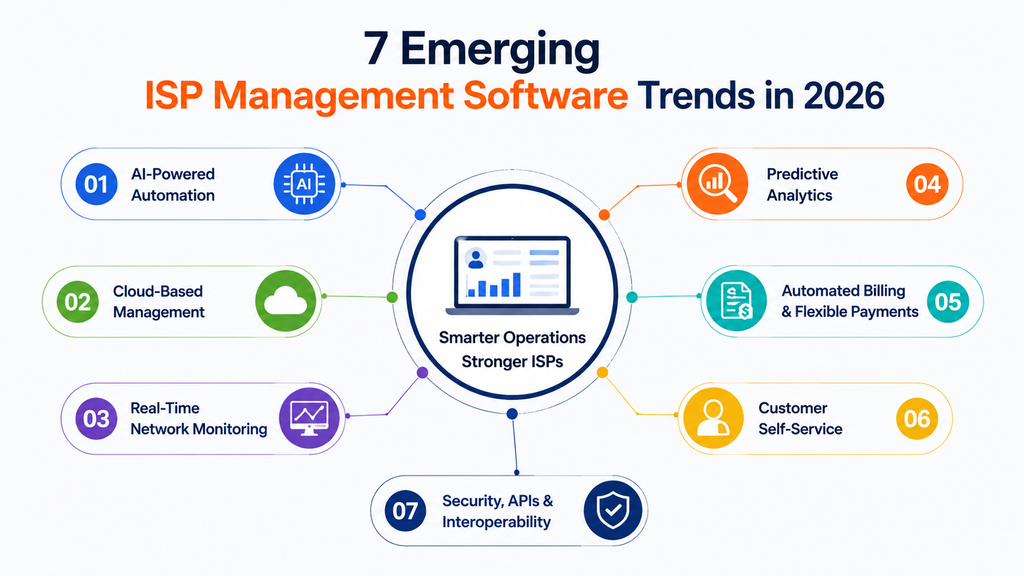
1. AI-Powered Automation Is Becoming a Priority
Artificial intelligence is moving from experimentation toward practical network and business operations. Telecom industry research in 2026 highlights the growing role of AI-driven and autonomous operations in improving efficiency, resilience, and customer experience.
For ISPs, this means management platforms are increasingly expected to automate repetitive activities such as customer onboarding, service activation, payment reminders, ticket classification, and network issue detection.
AI can also help analyze large amounts of operational data and identify unusual patterns before they become major problems. Instead of relying entirely on manual monitoring, teams can use intelligent alerts and automated workflows to respond faster.
2. Cloud-Based ISP Management Is Becoming the Standard
Cloud technology is transforming how businesses deploy and access management platforms. Cloud-based ISP management software allows teams to manage subscribers, plans, billing, usage, and operational information from a centralized environment.
This is particularly useful for growing ISPs managing multiple locations or expanding their customer base. Cloud-based platforms can reduce dependence on local infrastructure while making software updates, data access, and system scalability easier to manage.
The wider telecom industry is also moving toward cloud-native and composable architectures that can support more flexible, automated operations.
3. Real-Time Network Monitoring Is Gaining Importance
Customers expect internet services to work reliably at all times. Even short service interruptions can lead to complaints, support tickets, and customer churn.
As networks become more complex, real-time visibility is becoming an essential capability. Modern management platforms can bring network activity, subscriber information, usage patterns, and service status into a centralized dashboard.
This helps teams identify problems faster and prioritize issues based on their potential impact. Instead of discovering a problem only after customers report it, ISPs can move toward proactive monitoring and faster resolution.
Industry discussions around autonomous operations increasingly emphasize real-time, data-driven decision-making rather than reactive network management.
4. Predictive Analytics Will Help ISPs Move From Reactive to Proactive
Another important trend is the use of predictive analytics. Rather than simply showing what is happening now, intelligent systems can analyze historical and real-time data to identify potential future issues.
For example, an ISP may analyze bandwidth usage, customer behavior, payment patterns, and network performance to identify areas requiring attention.
Predictive insights can support capacity planning, customer retention, maintenance scheduling, and service optimization. As data volumes increase, having reliable and well-organized data will become increasingly important for AI-powered ISP operations.
5. Automated Billing and Flexible Payment Management
Billing remains one of the most important areas of ISP operations. Manual billing processes can create delays, errors, and unnecessary administrative work.
In 2026, ISPs are looking for more automated billing capabilities that can handle recurring payments, invoices, plan changes, payment reminders, account status, and service suspension workflows.
Flexible billing also allows providers to introduce different packages, usage-based plans, promotional offers, and customized customer plans more efficiently.
A connected billing and subscriber management environment can reduce manual work while providing customers with a clearer and more consistent payment experience.
6. Customer Self-Service Is Becoming More Important
Customer expectations are no longer limited to fast internet. Subscribers also want convenient ways to manage their accounts without contacting support for every small request.
Modern ISP management software is increasingly supporting self-service capabilities such as online payments, plan upgrades, usage visibility, account management, service requests, and notifications.
This can reduce pressure on customer support teams while giving subscribers faster access to information.
As digital experiences become a major part of customer retention, ISPs that make account management simple and accessible can create a stronger overall customer experience.
7. Security, APIs and Interoperability Are Becoming Essential
As ISP operations become more connected, security and interoperability are becoming critical considerations. Management systems need to communicate with network equipment, payment platforms, CRM systems, authentication services, and other business applications.
Open APIs and flexible architectures can make these integrations easier. At the same time, ISPs need strong access controls, monitoring, authentication, and data protection practices.
The shift toward AI-native telecom architectures is also increasing the importance of interoperable systems and shared APIs that allow different platforms and intelligent agents to work together securely.
For additional insight into the evolution of autonomous and AI-driven telecom operations, see TM Forum’s research on AI-native intelligent operations and Cisco’s 2026 perspective on autonomous network automation.
What These Trends Mean for ISPs
The biggest change is that ISP management is moving from simple administration toward intelligent, connected, and increasingly automated operations.
ISPs should evaluate platforms based not only on current requirements but also on their ability to support future growth. Important capabilities to consider include automation, cloud accessibility, real-time monitoring, predictive analytics, flexible billing, customer self-service, integrations, and strong security.
The right ISP management software can help providers reduce repetitive tasks, improve operational visibility, streamline billing, and deliver a better experience to subscribers.
Conclusion
The ISP landscape in 2026 is being shaped by AI, automation, cloud technology, predictive analytics, and increasingly connected digital experiences. Providers that adopt these capabilities can improve efficiency while preparing their operations for future growth.
As ISPs evaluate their technology stack, choosing a scalable and feature-rich ISP management software platform can be an important step toward building smarter and more efficient operations. Solutions such as Netzur can help ISPs bring key management and operational functions together in one platform.
FAQ
1. What is ISP management software?
ISP management software is a platform designed to help internet service providers manage subscribers, billing, plans, network-related operations, payments, and customer services from a centralized system.
2. What should ISPs look for in management software in 2026?
ISPs should consider automation, cloud-based access, real-time monitoring, predictive analytics, flexible billing, customer self-service, API integrations, scalability, and security when evaluating a platform.