
The demand for high-speed internet continues to rise as businesses, homes, educational institutions, and smart cities rely on uninterrupted connectivity. This growing demand makes starting an ISP business one of the most promising opportunities in 2026. Whether you’re planning to serve a local community or expand into enterprise internet solutions, success depends on combining reliable infrastructure with intelligent business management.
Launching an Internet Service Provider is no longer just about laying fiber cables. Modern ISPs must manage subscribers efficiently, automate billing, monitor network performance, and deliver excellent customer support. This guide explains everything entrepreneurs need to know before starting an ISP business.
Why Start an ISP Business in 2026?
Global internet consumption continues to grow with the adoption of cloud computing, IoT devices, AI applications, remote work, and 5G connectivity. Many rural and underserved areas still require reliable broadband providers, creating new opportunities for entrepreneurs.
An ISP business offers several advantages:
- Recurring monthly revenue
- High customer retention
- Growing demand for broadband services
- Opportunities for business and enterprise packages
- Expansion into managed WiFi and hotspot services
With the right technology stack and operational strategy, ISPs can scale rapidly while maintaining consistent service quality.
Step 1: Understand Your Target Market
Before investing in infrastructure, research your local market carefully.
Identify:
- Residential broadband demand
- Business internet requirements
- Existing competitors
- Coverage gaps
- Customer pricing expectations
Understanding customer needs helps determine your service packages, pricing model, and network capacity.
Step 2: Obtain Required Licenses and Compliance
Every country has different regulations for internet service providers. Before launching your ISP business, ensure you have:
- ISP licensing
- Spectrum permissions (if applicable)
- Business registration
- Tax compliance
- Data privacy compliance
Following local regulations prevents legal issues and builds customer trust.
To better understand global internet policies and digital infrastructure, explore the Internet Society’s resources on internet governance.
Step 3: Build Reliable Network Infrastructure
Infrastructure is the backbone of every successful ISP business.
Depending on your budget and location, you may choose:
- Fiber-to-the-Home (FTTH)
- Wireless ISP (WISP)
- GPON networks
- Ethernet broadband
- Hybrid infrastructure
Investing in scalable equipment allows future expansion without replacing the entire network.
Following internationally recognized ITU broadband and telecommunications standards helps ISPs build reliable, scalable, and future-ready networks.
Step 4: Implement Smart ISP Billing Software
Manual subscriber management quickly becomes difficult as your customer base grows.
Modern ISP businesses rely on automated billing systems that provide:
- Subscriber management
- Automated invoicing
- Online payment collection
- Bandwidth management
- Service activation
- Suspension automation
- Customer self-service portals
Automation reduces operational costs while improving customer satisfaction.
Step 5: Deploy AAA Authentication
A secure authentication system is essential for every ISP.
AAA (Authentication, Authorization, and Accounting) enables providers to:
- Authenticate subscribers securely
- Authorize internet access
- Record user activity
- Maintain accurate billing records
- Improve network security
Without centralized authentication, managing thousands of users becomes extremely challenging.
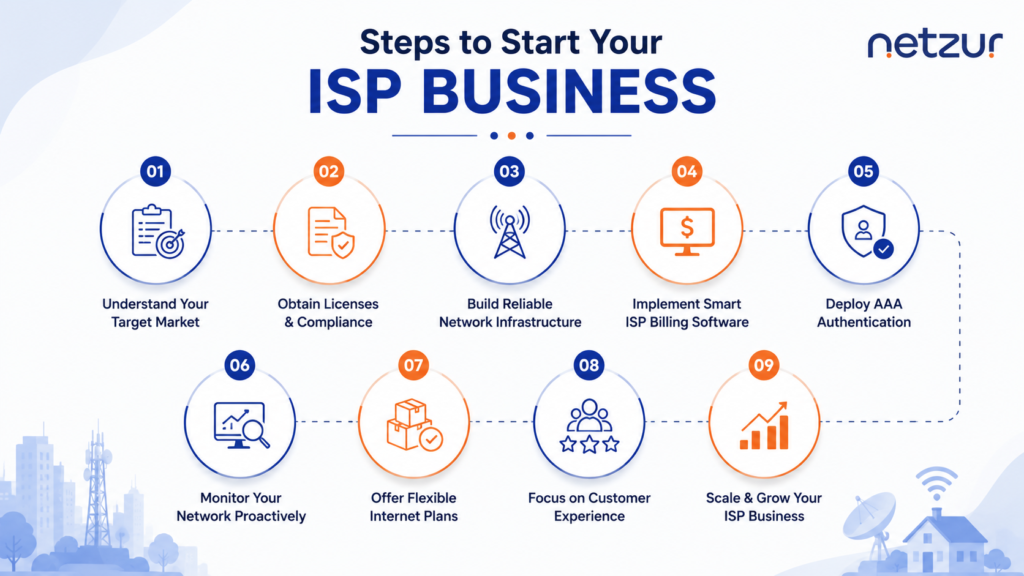
Step 6: Monitor Your Network Proactively
Network downtime directly impacts customer satisfaction.
Modern ISPs should continuously monitor:
- Network traffic
- Device health
- Customer usage
- Bandwidth consumption
- Service interruptions
- Router performance
Real-time monitoring enables faster issue resolution and minimizes downtime.
Step 7: Offer Flexible Internet Plans
Different customers have different internet requirements.
Successful ISP businesses typically offer:
- Home broadband plans
- Business internet packages
- Dedicated leased lines
- Hotel WiFi services
- Public hotspot solutions
- Enterprise connectivity
Flexible packages help maximize revenue while serving multiple customer segments.
Step 8: Focus on Customer Experience
Providing fast internet is only part of the business.
Customers also expect:
- Quick installation
- Reliable uptime
- Transparent billing
- Fast technical support
- Easy online payments
- Self-service account management
Excellent customer service significantly improves retention rates and reduces churn.
Essential Software Every ISP Business Needs
As your subscriber base grows, managing operations manually becomes inefficient.
A modern ISP should invest in software that includes:
- Subscriber Management
- RADIUS Authentication
- ISP Billing Software
- Bandwidth Management
- CRM Integration
- Payment Gateway Support
- Network Monitoring
- Customer Portal
- Reporting Dashboard
An integrated platform helps streamline operations while improving profitability.
Future Trends in the ISP Business
The ISP industry is rapidly evolving. Entrepreneurs entering the market in 2026 should prepare for:
- AI-powered network monitoring
- Cloud-based ISP management
- WiFi 7 adoption
- Smart city connectivity
- IoT network expansion
- Automated customer support
- Advanced cybersecurity solutions
- Predictive maintenance using analytics
Businesses that embrace automation and cloud technologies will have a competitive advantage.
Conclusion
Starting an ISP business in 2026 presents significant growth opportunities, but success depends on much more than internet connectivity. Entrepreneurs need reliable infrastructure, automated billing, secure subscriber authentication, proactive network monitoring, and exceptional customer support.
Solutions like Netzur simplify ISP operations by integrating subscriber management, billing automation, RADIUS authentication, bandwidth management, and network monitoring into a single platform. Investing in the right technology from the beginning helps reduce operational complexity while preparing your business for long-term growth.
FAQ
1. How much investment is required to start an ISP business?
The investment depends on factors such as location, network infrastructure, licensing, and equipment. Small regional ISPs typically require less investment than fiber-based providers serving large cities.
2. What software is essential for managing an ISP business?
A modern ISP business should use software that includes subscriber management, automated billing, RADIUS authentication, bandwidth management, payment integration, network monitoring, CRM functionality, and customer self-service capabilities.
