
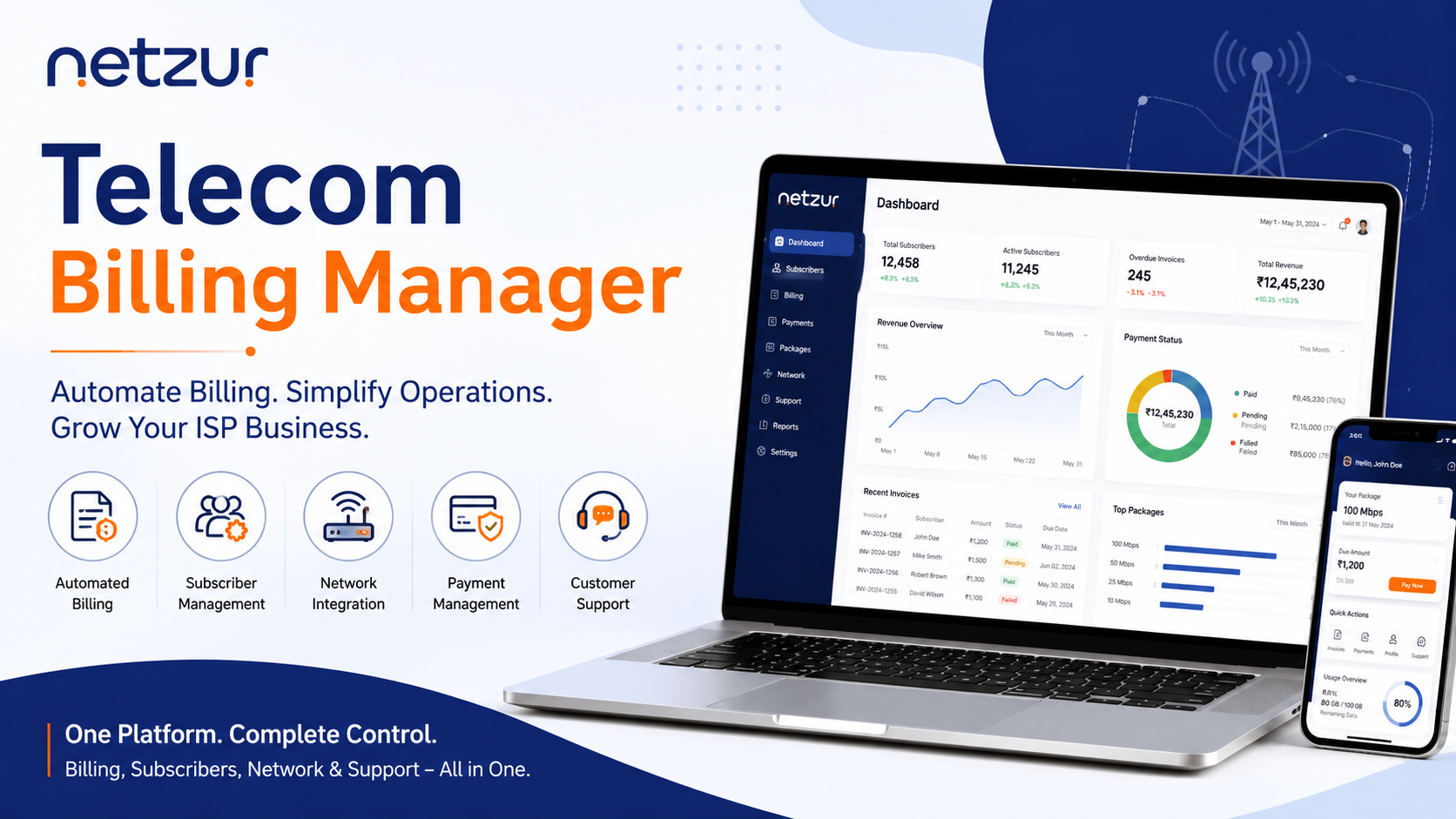
In today’s fast-evolving telecom industry, managing subscribers, invoices, payments, network usage, and customer support manually is no longer sustainable. As internet service providers (ISPs) scale their operations, they need a centralized system that streamlines billing, subscriber management, and operational workflows. That’s where a telecom billing manager becomes essential.
A telecom billing manager is more than just invoicing software. It acts as the operational backbone of an ISP by automating customer billing, managing payment collections, monitoring bandwidth usage, handling support tickets, and integrating with network infrastructure. Modern telecom providers require scalable and intelligent billing systems that reduce manual work while improving customer experience.
Why ISPs Need a Telecom Billing Manager
Telecom businesses deal with complex operational tasks daily. From prepaid and postpaid billing to bandwidth control and customer onboarding, managing everything manually creates inefficiencies and revenue leakage.
A robust telecom billing manager helps providers:
- Automate recurring invoices
- Track subscriber usage in real time
- Suspend overdue accounts automatically
- Manage franchisees and resellers
- Generate financial reports
- Handle customer complaints efficiently
- Integrate with payment gateways and routers
Without a centralized telecom billing system, providers often struggle with delayed payments, inaccurate billing, customer dissatisfaction, and operational bottlenecks.
According to Gartner, following telecom billing automation best practices helps ISPs improve billing accuracy, reduce operational costs, and scale efficiently.
Key Features of an Advanced Telecom Billing Manager
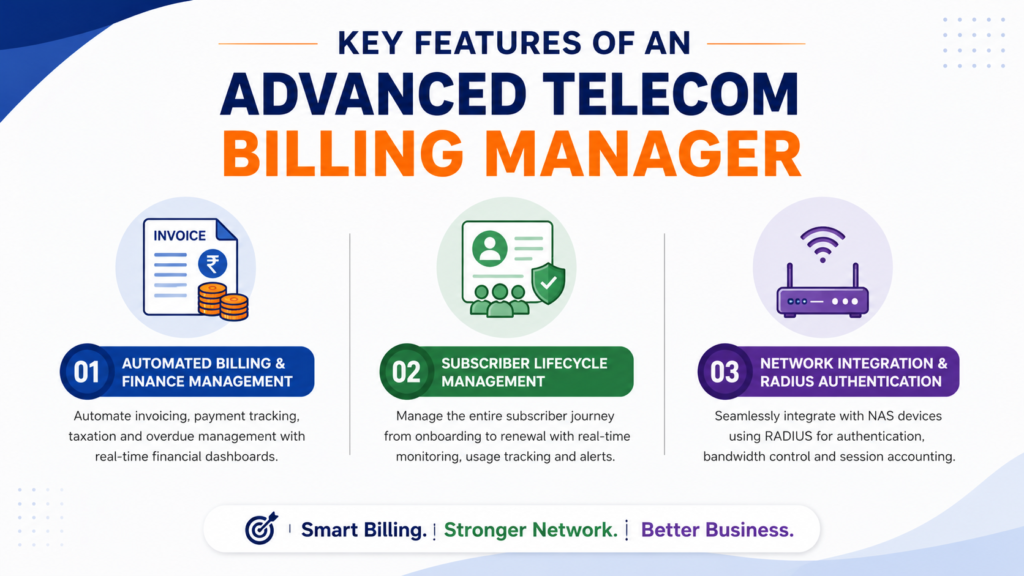
1. Automated Billing & Finance Management
One of the biggest advantages of a telecom billing manager is automated financial operations. A modern billing engine automates invoice generation, taxation, payment tracking, and service suspension for overdue accounts.
This eliminates manual calculation errors and improves cash flow management.
Key finance capabilities include:
- Automated invoicing
- Partial payment support
- Real-time financial dashboards
- Payment gateway integration
- Tax and compliance support
- Billing cycle customization
For ISPs with thousands of subscribers, automation can save hundreds of administrative hours every month.
2. Subscriber Lifecycle Management
A telecom billing manager should handle the entire subscriber journey – from onboarding to renewal and support.
Advanced subscriber management systems typically include:
- Real-time subscriber monitoring
- e-KYC support
- Usage tracking
- Prepaid and postpaid billing
- Automated alerts and notifications
- Customer self-care portals
This centralized approach improves operational transparency and customer retention.
3. Network Integration & Radius Authentication
Modern telecom operations require seamless integration between billing systems and network infrastructure.
Most enterprise-grade telecom billing platforms support multiple NAS devices including MikroTik, Cisco, Huawei, Juniper, and Accel-PPP with Radius-based authentication and policy enforcement.
Key capabilities include:
- PPPoE authentication
- Hotspot management
- Dynamic bandwidth control
- Queue management
- Real-time session accounting
- TR-069 ACS integration
These features ensure customers receive the correct bandwidth plans automatically based on payment status.
Modern telecom providers rely on advanced Cisco network management solutions to integrate billing systems with routers, NAS devices, and authentication infrastructure.
Benefits of Using a Telecom Billing Manager
Improved Revenue Collection
Automated reminders, overdue notifications, and instant payment updates help reduce delayed payments and improve revenue recovery.
Reduced Operational Costs
Automation minimizes manual intervention in billing, ticketing, and customer management, reducing staffing overhead.
Better Customer Experience
Subscribers gain access to self-service portals, payment options, usage history, and support tracking – all from one platform.
Scalability
As subscriber numbers grow, a telecom billing manager scales operations without increasing complexity.
Regulatory Compliance
Advanced billing platforms maintain detailed logs, audits, and compliance records essential for telecom regulations.
Challenges Solved by Telecom Billing Software
Many ISPs and telecom operators face common operational issues such as:
- Revenue leakage due to billing errors
- Delayed invoice generation
- Manual subscriber provisioning
- Lack of centralized reporting
- Poor customer communication
- Difficulty managing franchise networks
A telecom billing manager solves these challenges through automation, centralized dashboards, and real-time monitoring capabilities.
By reducing repetitive administrative work, telecom providers can focus more on customer acquisition, service quality, and network expansion.
The Future of Telecom Billing Management
The telecom industry is moving rapidly toward automation, AI-driven analytics, and cloud-based infrastructure. Future-ready telecom billing managers will increasingly focus on:
- Predictive revenue analytics
- AI-powered customer support
- Automated fraud detection
- Smart bandwidth optimization
- Cloud-native scalability
- Integrated customer engagement tools
Businesses that continue relying on outdated manual systems may struggle to compete in a highly digital telecom landscape.
By investing in an intelligent telecom billing manager, providers can improve operational efficiency, reduce churn, and scale confidently.
Conclusion
A telecom billing manager is no longer optional for modern ISPs and telecom providers. It plays a critical role in automating billing operations, improving subscriber management, ensuring accurate financial tracking, and delivering a better customer experience.
Platforms like Netzur help telecom businesses simplify operations through integrated billing automation, subscriber management, CRM, ticketing, and network monitoring solutions.
FAQs
What is a telecom billing manager?
A telecom billing manager is a software platform that automates billing, subscriber management, payment tracking, and operational workflows for telecom providers and ISPs.
Why is billing automation important for ISPs?
Billing automation reduces manual errors, improves payment collection, saves operational costs, and enhances customer satisfaction through accurate invoicing and real-time account management.
Can a telecom billing manager integrate with routers and network devices?
Yes, advanced telecom billing systems can integrate with MikroTik, Cisco, Huawei, Juniper, and other NAS devices using Radius authentication and network management protocols.
Does telecom billing software support prepaid and postpaid billing?
Yes, most modern telecom billing platforms support both prepaid and postpaid billing models along with automated invoicing, usage tracking, and payment management.
